Lighting solutions
en

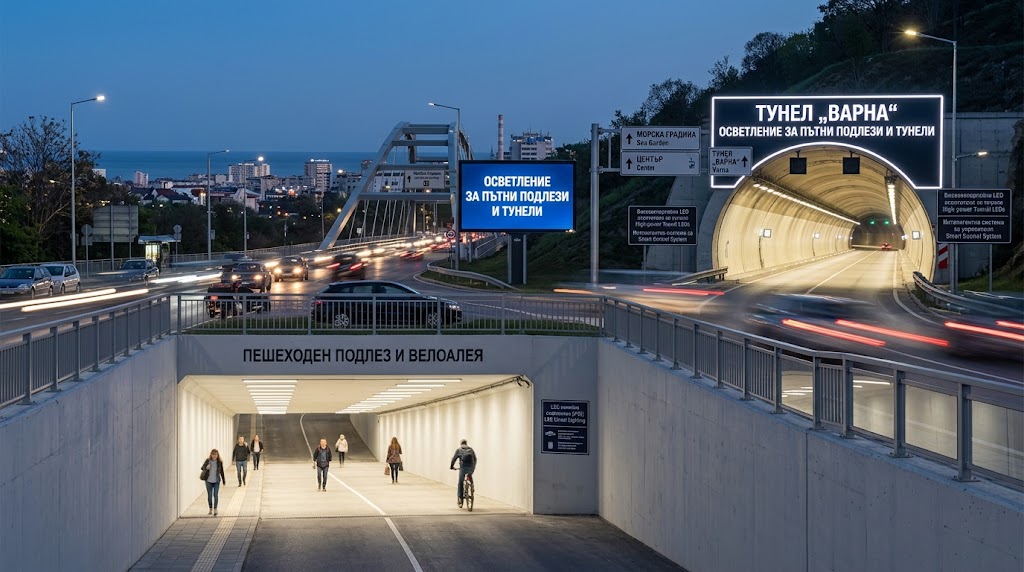
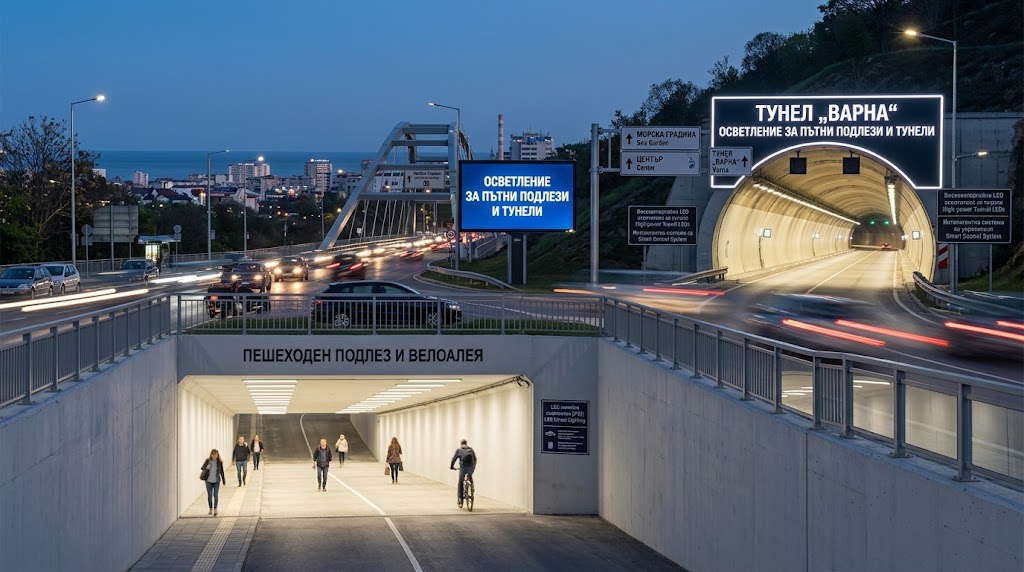
Underpass and tunnel lighting design must provide sufficient visibility before entry, gradual visual adaptation and reliable orientation throughout the interior. The required lighting cannot be defined by a single value for the entire structure. It depends on length, geometry, traffic type, speed, daylight conditions at the portal and the specific risks of the project.
In road tunnels, photometric design is directly related to traffic safety. Pedestrian underpasses involve different priorities, including clear visibility of routes, people, steps, exits and obstacles. The two applications should therefore be assessed separately.
CEN/TR 14380:2024 describes current European practice for road tunnel and underpass lighting using a photometric approach that considers both daylight and traffic conditions. CIE 088:2004 divides a road tunnel into successive areas: the access zone, threshold zone immediately inside the portal, transition zone, interior zone and, where relevant, an exit zone.
This zoning is important because the driver's eyes cannot adapt instantly from a bright outdoor environment to a much darker interior. The lighting system must manage this adaptation progressively.
When approaching a tunnel during the day, the interior can appear as a dark opening. If a vehicle, person or obstacle cannot be identified early enough, the driver may have insufficient time to react safely.
The required luminance at the beginning of the tunnel is determined by specialist calculation. Depending on the selected design method, this can include external luminance around the portal, design speed, stopping distance, tunnel orientation, visible sky, road surface and surrounding structures.
Two tunnels of similar length can therefore require very different entrance lighting solutions.
After the threshold zone, lighting should not fall abruptly to the interior level. The transition zone allows the driver's visual system to adapt progressively to the lower luminance deeper inside the tunnel.
In the interior zone, the objective is to maintain sufficient visibility of the road, tunnel walls, vehicles and potential obstacles. In long tunnels, this zone can represent most of the installation and may operate at different daytime and night-time levels.
In shorter underpasses, daylight entering from both ends can have a substantial influence. This should be evaluated through calculation rather than automatically applying a lighting concept intended for a long road tunnel.
Alternating bright and dark sections can make obstacles more difficult to identify and can create unnecessary visual discomfort. The lighting design should therefore assess not only average luminance or illuminance, but also uniformity along the direction of travel.
Luminaire positions and optics must also control glare. Bends, changes in gradient, entrance portals and locations where luminaires appear directly in the driver's field of view require particular attention.
Pedestrian underpass lighting should support orientation and early recognition of other people and obstacles. Lighting the floor alone is not sufficient. Vertical illumination of faces, walls, entrances and information elements also contributes to visibility.
Steps, ramps, changes in level and route intersections should be clearly identifiable. Where the underpass operates continuously, different lighting levels can be used according to daylight and occupancy, provided that the control strategy does not create unsafe dark sections.
A tunnel must retain appropriate visual guidance if the normal power supply fails. Road tunnels require safety lighting and evacuation guidance appropriate to their category and the regulations applicable to the specific infrastructure.
For tunnels within its scope, Directive 2004/54/EC requires normal lighting to provide appropriate visibility, safety lighting to maintain minimum visibility following a power failure and evacuation lighting to guide users leaving the tunnel on foot.
The final arrangement needs to be coordinated with emergency power supplies, escape exits, traffic management and the other tunnel safety systems.
Tunnel luminaires can be exposed to dust, water, vehicle contamination, vibration and mechanical stress. Some installations also involve aggressive cleaning procedures or potentially corrosive conditions.
Specification should therefore consider ingress protection, mechanical resistance, housing materials, fixing components and the operating conditions of the LED driver. A high IP rating alone does not demonstrate resistance to every environmental load present in a tunnel.
Tunnel lighting does not necessarily need to operate at maximum output continuously. Road tunnel systems can use information about external luminance to adapt threshold and transition lighting to changing daylight conditions.
The design can include daytime, overcast, night-time and other operating stages. Changes between these modes must preserve the required visibility and uniformity. Control architecture should also consider safe operation if a sensor, controller or communication link fails.
Maintenance inside an operational tunnel can require lane restrictions or temporary road closures. Luminaire positions, electrical panels and control equipment should therefore be planned to support safe and efficient servicing.
Electrical zoning, safe isolation, access for cleaning and replacement and the ability to service one section without unnecessarily switching off large parts of the installation should be considered during design. The maintenance concept must also account for dirt accumulation on luminaires and tunnel surfaces because this affects actual photometric performance over time.
Length, traffic speed, direction of travel, geometry, daylight, road surfaces, traffic volume and emergency strategy can all significantly change the required solution. A standard layout or a single illuminance value cannot replace project-specific photometric calculations and coordination with the other engineering systems.
Polaris Lighting provides lighting design and solutions for tunnels and underpasses, including photometric calculations, luminaire selection, lighting controls and emergency operating modes. Contact us if you need a lighting design solution for a tunnel or underpass.
Important: Because tunnel lighting is directly related to traffic and evacuation safety, the technical parameters and applicable regulatory requirements for the specific project must be reviewed by a competent lighting or infrastructure designer before publication and implementation.