Lighting solutions
en

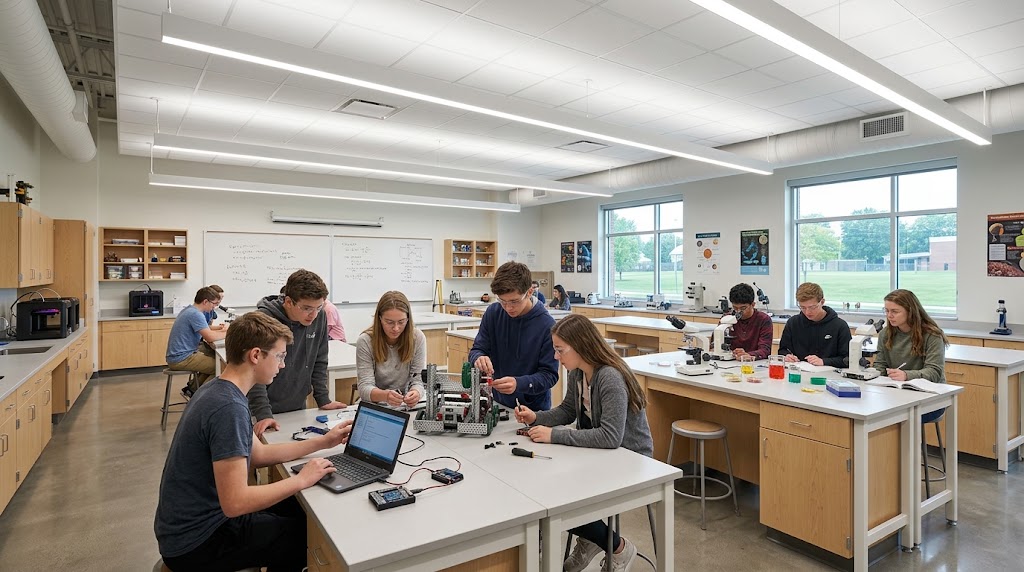
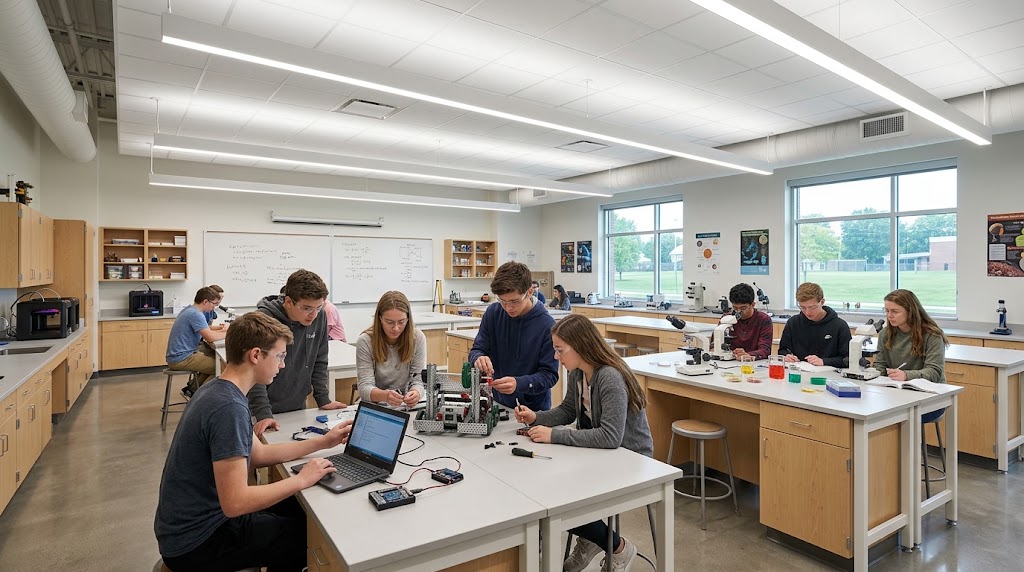
Lighting for STEM classrooms and teaching laboratories needs to respond to the different activities taking place within the same room. Students may move from experimental work at a bench to observing a demonstration, using a computer or interactive display and examining materials or colours. One fixed general lighting condition is therefore rarely sufficient.
A reliable design divides the room into functional areas and defines the lighting according to the actual visual task. Workbenches, demonstration tables, displays and technical installations should all be coordinated before the luminaires are selected.
Workbenches are the main task areas. Students may read scales and instruments, assemble components, observe samples and carry out practical exercises on these surfaces. Lighting should reach the bench evenly without students or equipment creating strong shadows over the task.
Luminaires should not simply follow the geometry of the ceiling. Bench positions, working height and the way students stand around each table influence the appropriate lighting arrangement. Photometric calculations can verify illuminance, uniformity and potential problem areas before installation.
Not every practical task requires the same lighting setting. Detailed component work needs good visibility across the task surface, while some physics or biology experiments may require the general lighting level to be temporarily reduced.
Dimming and separately controlled lighting groups therefore provide more flexibility than simple on-off switching. Where an experiment requires darker conditions, sufficient safety lighting should remain available for orientation and safe working according to the activity and the school's procedures.
STEM teaching frequently involves the teacher demonstrating a process, model or experiment to a group. The demonstration bench should therefore be treated as an individual task area rather than simply relying on the room's general lighting.
Light should reach the work surface and demonstration object without the teacher casting a strong shadow across it. If a camera is used to show the demonstration on a screen, reflections from glass, glossy materials and laboratory equipment should also be considered.
Interactive displays, monitors and projectors are common in STEM environments. A bright luminaire reflected in a screen can reduce contrast and make information more difficult to read.
The display position should therefore be known at the lighting design stage. Luminaires near the screen can form a separate control group and be dimmed during presentations while sufficient light remains over workbenches for note-taking and practical work.
Low glare depends not only on the luminaire specification but also on its position, viewing directions and room geometry. These factors should be evaluated together.
Where students need to distinguish the colours of materials, wires, chemical indicators, models or other components, colour rendering becomes an important design criterion. Luminaires with Ra above 90 can be a suitable choice for areas where accurate visual colour assessment matters.
Not every STEM activity requires the same colour-rendering performance. The requirement should follow the teaching task, and more detailed colour characteristics should be reviewed where especially accurate colour judgement is necessary.
A STEM classroom can use several predefined lighting scenes:
The controls should remain straightforward for teaching staff. A practical system allows the room to change from one activity to another without requiring individual adjustment of every luminaire.
STEM rooms can contain extraction systems, laboratory cabinets, electrical services, gas and water points, robotic equipment, 3D printers, suspended displays and other technical installations. All of these can affect luminaire positioning and future maintenance.
A luminaire should not be installed behind ductwork or another service that blocks its light distribution. Drivers and other serviceable components should also remain accessible without dismantling complex laboratory installations.
Where a particular area is exposed to chemicals, moisture, dust or other special conditions, the required IP protection, materials and environmental resistance of the luminaire should be determined separately for the actual application.
A reliable design requires the classroom layout, locations of workbenches and demonstration tables, displays, laboratory equipment, technical services and a description of the activities to be carried out. Photometric calculations can then determine the lighting groups, control strategy and appropriate luminaires.
Polaris Lighting provides lighting design and supply for STEM classrooms and teaching laboratories, including work and experimental areas, demonstration benches, display lighting, dimming and scene-based controls. Contact us if you need lighting design and supply for a STEM classroom or teaching laboratory.
