Lighting solutions
en

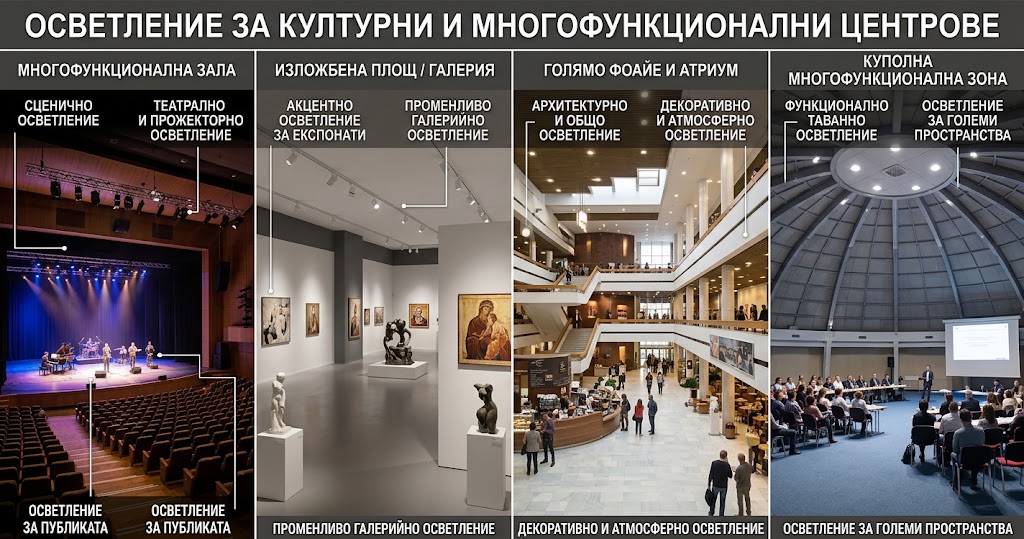
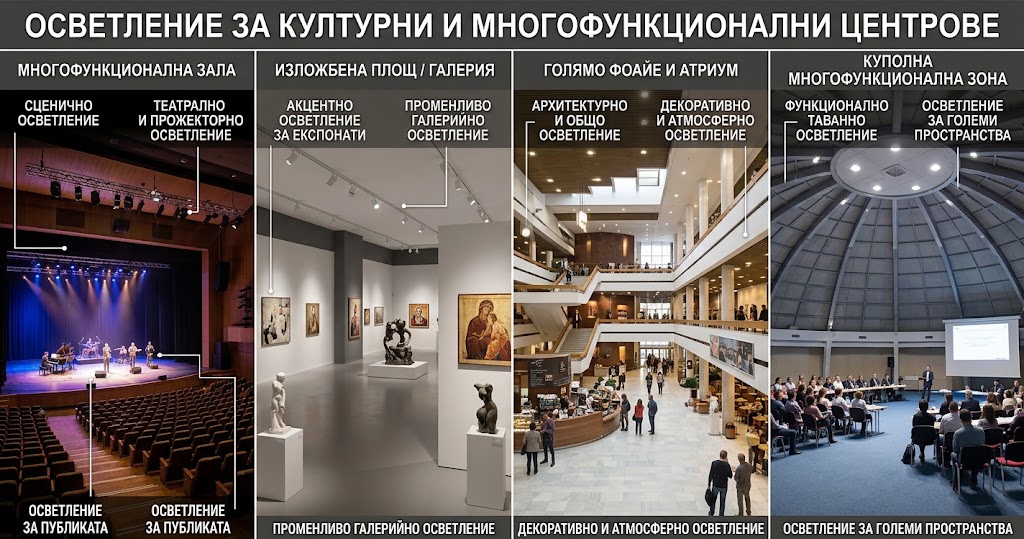
Cultural centre lighting should allow the same space to support an exhibition, training session, presentation or stage event without requiring a new lighting installation every time the programme changes. A successful design therefore combines a reliable functional lighting layer with flexible track or magnetic systems and independently controlled lighting scenes.
Cultural centres often include halls of different sizes, foyers, exhibition spaces, stages, learning rooms and exterior areas. Each performs a different visual task and should be able to operate independently or as part of a larger event.
A common mistake in multi-purpose buildings is to illuminate every room in the same way. Exhibitions require controlled accents on objects, teaching needs uniform functional light and a stage must be visually separated from the audience.
The project should therefore begin by defining functional lighting zones. General illumination provides a stable base, while accent lighting can be redirected and adjusted according to the current programme.
The location, size and type of exhibition objects can change regularly. Paintings require a different lighting approach from sculptures, photographs or objects displayed in showcases. A fixed spotlight may work perfectly for one exhibition and become ineffective when the layout changes.
Three-phase track systems are particularly useful in this environment. Spotlights can be moved along the track, rotated and redirected to match a new display. Different beam distributions can provide a narrow accent on an individual object or broader illumination across an exhibition wall.
Where sensitive artworks are displayed, any exposure limits defined by the specialists responsible for the collection should also be incorporated into the lighting brief.
The lighting task changes significantly during educational activities. Participants need to read, write and use laptops while still seeing the lecturer and presentation screen comfortably.
These rooms benefit from relatively uniform general illumination with controlled glare. Lighting close to the presentation screen should be independently controllable so that it can be reduced without leaving the entire room dark.
A stage used for lectures, concerts, panel discussions or performances should not depend on the general room lighting. Light towards speakers or performers should be controlled separately from the audience, aisles and architectural lighting.
Where events are recorded, sufficient vertical illumination towards faces is also important. Camera and luminaire positions should be coordinated to minimise harsh shadows and direct glare.
Track lighting is useful where fixtures need to change position or direction regularly. Magnetic systems provide similar flexibility within a more integrated architectural format, allowing different lighting modules to be combined within one system.
This is particularly useful in foyers, small galleries and multi-purpose rooms where temporary exhibitions, registration areas or presentation spaces may appear in different locations.
Flexibility still needs to be designed deliberately. Tracks and magnetic lines should be positioned to serve realistic future exhibition and event zones rather than simply following the geometry of the ceiling.
A foyer needs to provide clear orientation towards halls, cloakrooms, information points and toilets. Many cultural centres also use these spaces for temporary exhibitions, receptions, registration or smaller events.
Functional illumination can therefore be combined with track spotlights, decorative pendants or linear systems. The space remains comfortable for circulation while gaining the flexibility to support a different visual concept when required.
Dimming and grouped lighting controls reduce the need for manual adjustment before every event. A multi-purpose cultural centre can benefit from several predefined operating modes.
Exterior lighting should make the main entrance easy to identify while providing visibility along approaches, stairs and pedestrian routes. Façade accents can reinforce the architecture and identity of the cultural centre without creating unnecessary spill light into the surrounding environment.
Exterior luminaires should be selected according to actual exposure to moisture, dust and mechanical impact, while maintenance access should be considered during design rather than after installation.
Emergency and exit lighting systems should remain independent of decorative and stage lighting modes. If the normal lighting supply fails, visitors need to identify exits, stairs and escape routes clearly.
EN 1838:2024 specifies a minimum horizontal illuminance of 1 lx at floor level within the defined escape-route area. Large open halls and foyers may also require open-area emergency lighting depending on their layout and risk assessment.
The design process starts with architectural drawings, room functions, stage locations, potential exhibition walls, training spaces, foyers and exterior circulation routes. The permanent lighting layer, flexible accent zones, controls and emergency systems can then be developed around these actual operating scenarios.
Polaris Lighting provides lighting design, photometric calculations, track, magnetic, linear, decorative and emergency lighting solutions for cultural centres and multi-purpose public spaces. Contact us if you need flexible lighting for exhibitions, learning spaces, stages, events, foyers or exterior areas.
