Lighting solutions
en

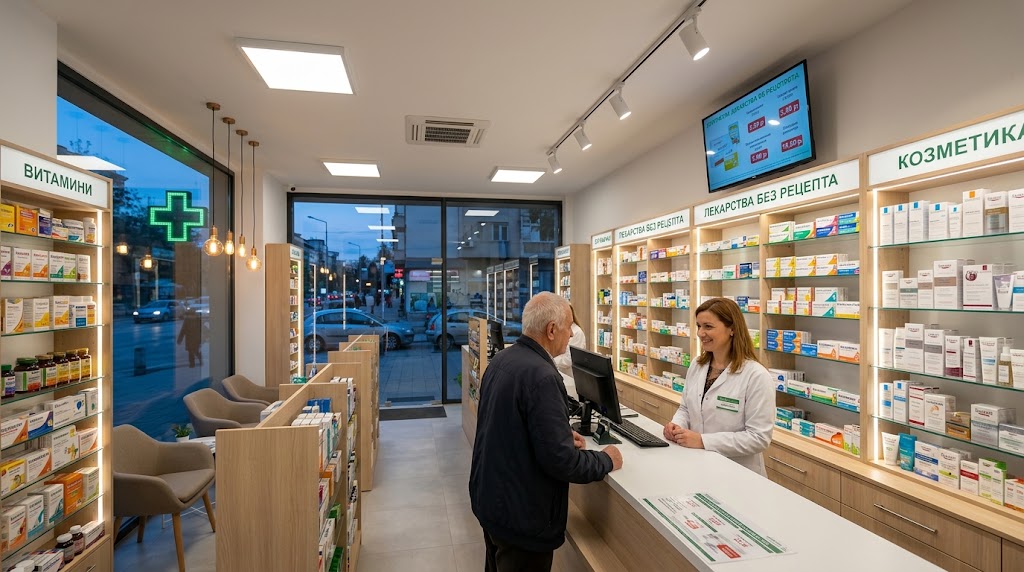
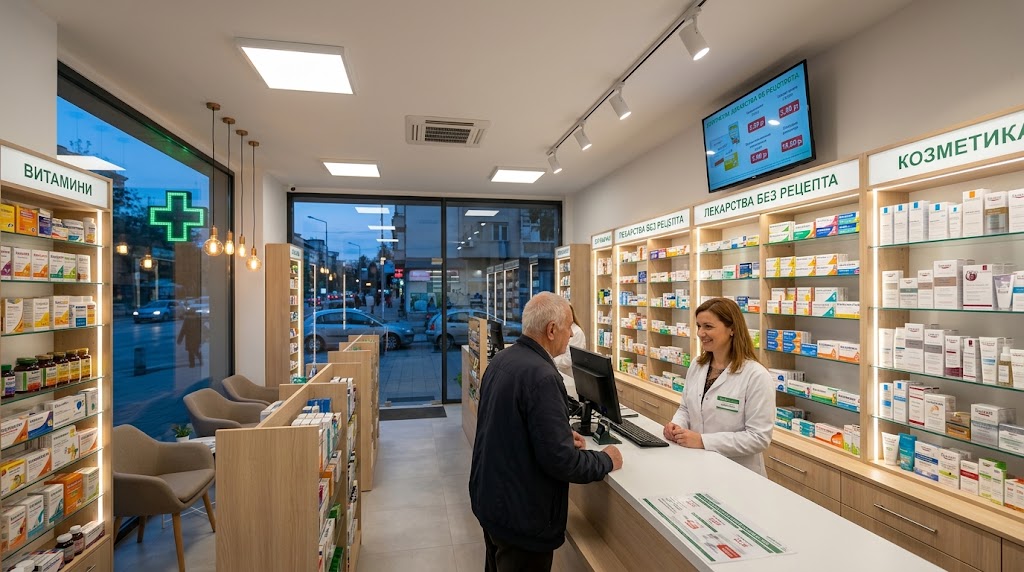
Pharmacy lighting has to meet two different needs: a clear and comfortable environment for customers and precise working light for staff handling prescriptions, products, labels and checkout systems. A successful design is therefore determined not only by total lumen output but by where the light falls, how evenly shelves are illuminated and which areas need additional visual emphasis.
A pharmacy is a retail environment, but many of its visual tasks require greater precision than ordinary product browsing. Customers read small print on packaging and price labels, compare products and search for specific categories. Pharmacists work with prescriptions, computer displays and numerous packages that may look very similar.
EN 12464-1:2021 specifies 300 lx maintained illuminance for general retail sales areas and a minimum colour rendering index of Ra 80. Illuminance alone, however, is not enough. The standard also calls for sufficient vertical illumination on shelving, because this is where products and the information customers need to read are actually located.
A common problem is adequate light on the floor and aisles while the lower sections of tall shelving remain dark. This usually results from inappropriate light distribution or luminaires positioned according to the aisle rather than the shelf face.
During design, vertical illuminance should be checked across the height of the shelving. Linear systems, suitable asymmetric optics or correctly positioned spotlights can improve the visibility of packaging without unnecessarily increasing the power of the entire installation.
Small print, glossy boxes and transparent packaging can remain difficult to read even in a bright space. Direction of light, reflection control and colour rendering all affect visual clarity.
Ra 80 is the baseline for general retail areas. Where more accurate colour differentiation and a more natural presentation of products are desired, luminaires with Ra 90 or higher can be specified. This can be particularly useful when closely related product ranges are distinguished primarily by colour coding.
Uniform ambient lighting does not mean that the pharmacy has to look visually flat. Accent lighting can distinguish dermocosmetics, seasonal offers, promotional displays, new products or individual categories.
The aim is to create a controlled contrast with the surrounding shelves. If every display is treated as an accent, the visual hierarchy disappears. If contrast becomes excessive, bright areas can create visual fatigue while adjacent sections appear unnecessarily dark.
Three-phase track systems are a practical option for product zones that change regularly because spotlight position and direction can be adjusted without rebuilding the complete lighting installation.
EN 12464-1:2021 specifies 500 lx for checkout areas in retail premises, together with higher uniformity and stricter glare control. These criteria support work with payments, documents and digital displays.
The prescription counter involves particularly detailed visual tasks. Pharmacists need to read prescriptions, labels, dosages and product information accurately. The work surface should therefore receive direct, uniform illumination without strong shadows from the user's hands or body and without distracting reflections on monitors.
Decorative effect is not the priority in storage rooms. Fast product identification, readable labels and clear visibility across shelving are more important.
Luminaire positions should follow the storage aisles and rack layout. In rooms that are occupied only intermittently, presence sensors can prevent lighting from operating at full output throughout the pharmacy's complete opening hours.
A pharmacy window has a different purpose from the main sales floor. Stronger contrast can be used to highlight communication materials or selected product groups. Directional luminaires should be positioned to reduce reflections in the glass and avoid direct glare toward people outside.
Where significant daylight is available, controls can reduce electric lighting during the day and increase output as natural light falls, maintaining a visible and clearly structured display after dark.
Energy-efficient pharmacy lighting is not simply a matter of selecting low-wattage LED fixtures. Luminous efficacy in lm/W, optics, the number of luminaires required, operating hours and control strategies all influence actual energy consumption.
The process starts with the floor plan, ceiling heights and the actual positions of shelving, checkout counters, prescription worktops, storage and window displays. We then define the required illuminance, light distribution, colour rendering and controls for each zone.
Photometric calculations allow us to assess not only average lux values but also uniformity, vertical illumination on shelving and areas where shadows or glare may occur. This makes it possible to design the lighting around the way the pharmacy is actually used.
Polaris Lighting provides lighting design, luminaire selection and supply for pharmacies, including shelves, product areas, checkout and prescription counters, storage areas and window displays. Contact us if you need a complete pharmacy lighting solution focused on visibility, product presentation and energy efficiency.
