Lighting solutions
en

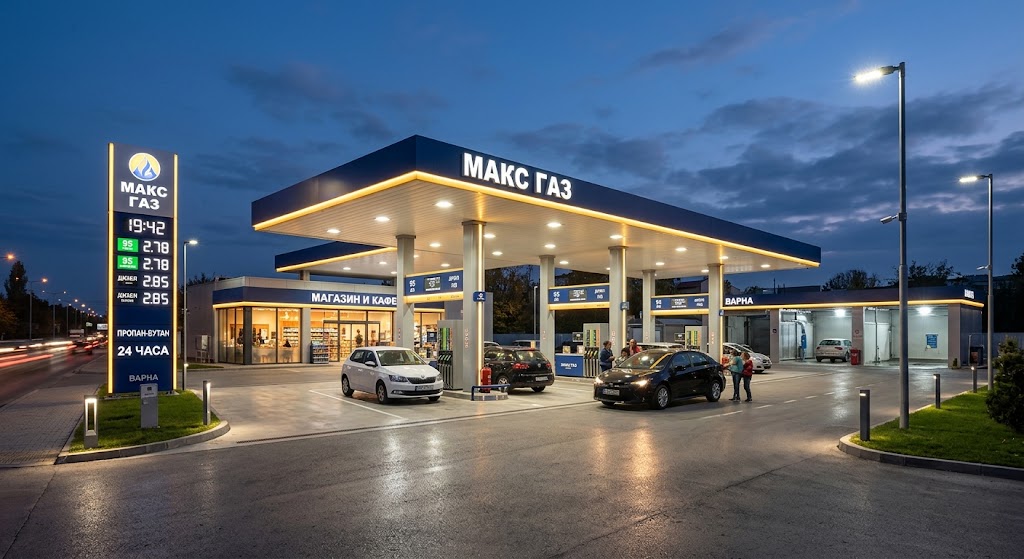
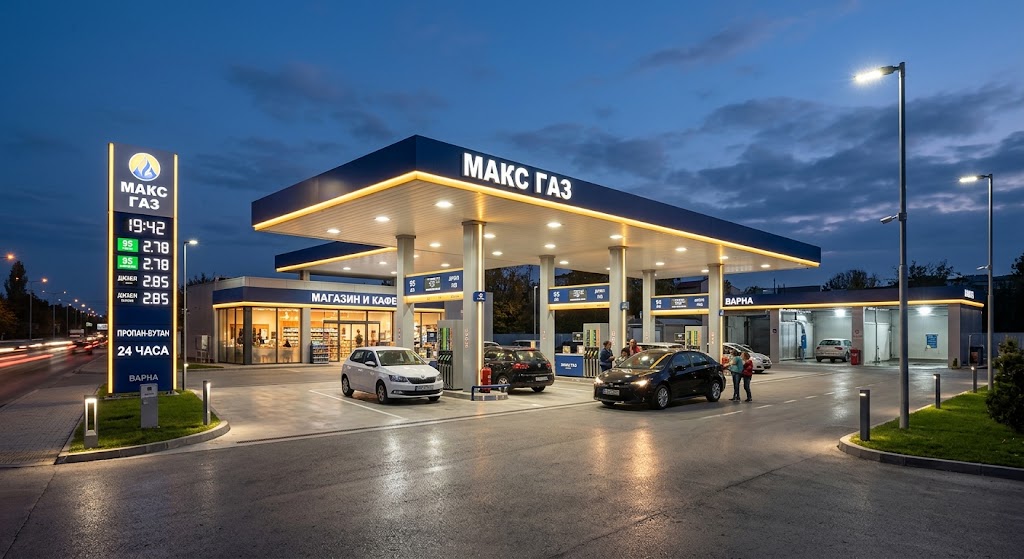
Petrol station lighting needs to provide clear visibility for drivers, customers and staff across a site that often operates 24 hours a day and contains areas with very different requirements. Canopies and pump islands need uniform controlled light, the shop requires retail lighting, parking areas need clear orientation, while potentially explosive locations require separate risk assessment and appropriately certified equipment.
Good visibility at a petrol station does not mean maximising brightness everywhere. Fuel dispensing, vehicle circulation, parking, retail, car washing and service areas should be treated as separate lighting zones, each with appropriate distribution, uniformity, environmental protection and control.
The current EN 12464-2:2024 for outdoor work places addresses both lighting performance and visual comfort, including the limitation of obtrusive light. This is particularly relevant for roadside sites, where poorly aimed luminaires can create unnecessary glare for approaching drivers.
Canopy luminaires should make the vehicle, dispenser, hoses, payment interface and surrounding circulation area clearly visible. Large differences between bright patches and dark areas can make orientation more difficult and may also reduce the usefulness of CCTV images.
Suitable wide or asymmetric distributions allow light to be directed toward the working area rather than toward the canopy fascia, neighbouring land or the road. Maintenance access should also be considered when recessed fixtures are specified, especially on sites that operate continuously.
Areas around fuel dispensers, vents, tank filling points and other process equipment should not be classified as hazardous simply by visual judgement. Directive 1999/92/EC defines Zones 0, 1 and 2 for gases, vapours and mists according to how often and for how long an explosive atmosphere may be present.
The exact boundaries and classification of all potentially hazardous areas must be determined and verified by a competent designer. Luminaires, electrical connections and other equipment can then be selected according to the identified zone and the applicable ATEX requirements.
A high IP rating does not by itself make a luminaire suitable for an explosive atmosphere. The relevant ATEX marking, certification and technical documentation must be checked for the specific application.
Inside the shop, the priorities are easy orientation, clear product visibility and well-lit checkout and service areas. Shelving needs sufficient vertical illumination, while refrigerated displays and promotional areas can be supported by controlled accent lighting.
The retail interior does not need to reproduce the brightness of the fuel canopy. A controlled transition between outside and inside is usually more comfortable, particularly at night.
Parking areas, entrances, exits and pedestrian routes need to make road boundaries, kerbs, pedestrians and obstacles easy to recognise. Pole-mounted or building-mounted luminaires should provide useful coverage while keeping direct glare under control.
The transition from a relatively bright canopy to a darker site perimeter deserves particular attention. Excessive contrast can make visual adaptation more difficult for drivers leaving the fuelling area.
A car wash exposes lighting equipment to water, spray, high humidity, cleaning chemicals and potentially mechanical impact. Luminaires and electrical connections should therefore be selected according to the actual conditions, including appropriate IP and IK protection, housing materials and corrosion resistance.
Uniform linear lighting can work particularly well in enclosed or tunnel car washes because it reduces shadows around the vehicle and supports staff visibility. The final specification depends on the wash technology and cleaning process.
Canopy fascias, logos, price totems and promotional signs should remain clearly visible from the road without becoming sources of excessive glare. Higher luminance does not automatically improve legibility.
Separate control or dimming can allow signage to respond to the time of night and surrounding ambient conditions. This keeps branding visible while reducing unnecessary brightness and energy consumption.
Emergency lighting should be designed separately from normal and advertising lighting. Where applicable, EN 1838:2024 specifies a minimum of 1 lx on escape routes and 0.5 lx in defined open anti-panic areas.
Exits, firefighting equipment and other safety points need to remain identifiable if the normal lighting supply fails. Requirements for process emergency points and hazardous locations must be defined by the relevant fire, electrical and process-safety design.
The process begins with the layout of the canopy, dispensers, shop, parking, car wash, advertising elements and vehicle and pedestrian routes. Photometric calculations are then used to check illuminance, uniformity, vertical visibility and possible glare.
Potentially hazardous locations are treated separately. Their classification and the final suitability of specific luminaires and electrical equipment must be reviewed and verified by a competent designer before specification and installation.
Polaris Lighting provides lighting design, luminaire selection and supply for petrol stations, including canopies, shops, parking areas, car washes and exterior spaces. Contact us if you need a lighting project or lighting solutions for a petrol station. Any solution intended for a potentially explosive or otherwise hazardous area must be coordinated and verified by a competent designer.