Lighting solutions
en

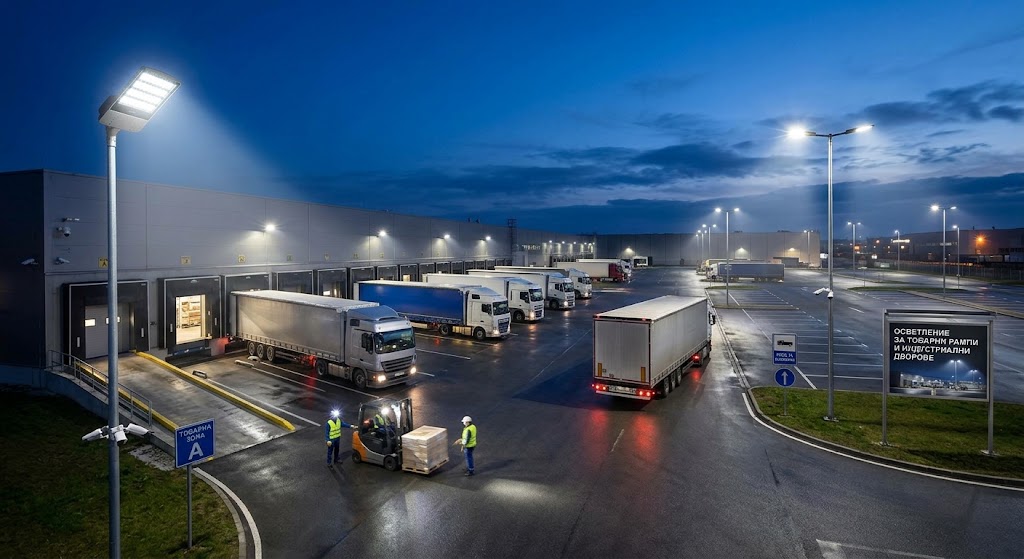
Loading dock and industrial yard lighting must provide clear visibility in areas where trucks, forklifts and pedestrians may move at the same time. A successful installation is not defined by high illuminance alone. Uniformity, glare control, correct floodlight positioning and coordination with CCTV cameras and traffic routes are equally important.
The design should follow the actual logistics of the site. Approaches to loading docks, vehicle turning areas, loading positions, pedestrian routes and building façades have different functions and do not necessarily need to operate at the same lighting level throughout the night.
EN 12464-2:2024 addresses outdoor workplaces according to the activity performed. For mixed traffic areas, vehicle turning and stationary loading and unloading points, the standard specifies 50 lx maintained average illuminance with a minimum uniformity of 0.40. Regular vehicle traffic at speeds up to 40 km/h is treated separately.
These figures form part of the design criteria rather than a complete lighting solution. Photometric calculations should also consider the yard width, mounting height, vehicle routes, type of handling equipment, parked trailers, surrounding buildings and the reflective properties of the ground surface.
Drivers need to identify other vehicles, pedestrians, kerbs, markings and obstacles while moving both forwards and in reverse. Isolated bright areas do not compensate for dark sections between them.
Turning areas, intersections between pedestrian and vehicle routes and spaces between parked trucks deserve particular attention. Large vehicles can create substantial shadows themselves, so floodlight positions should be tested against the actual yard geometry.
At a loading dock, the edge of the platform, docking equipment, rear of the vehicle and the space between the building and trailer should remain clearly visible. Drivers, warehouse staff and materials-handling equipment may all use the area simultaneously.
General yard lighting may not provide sufficient illumination inside a trailer or container. Dedicated local lighting can be added where required, provided that it does not create direct glare for drivers or strong reflections from metal surfaces.
A surveillance camera and the human eye do not respond to a scene in exactly the same way. A high illuminance reading at one location does not guarantee useful video if the camera sees extreme differences between bright and dark areas.
Luminaires should not shine directly into camera lenses because this can create glare, reflections and loss of image detail. Cameras using integrated infrared illumination can also be affected by nearby walls, canopies, signs and other reflective surfaces.
Camera and luminaire positions should therefore be coordinated during the design process. The required amount of visible light will also depend on the actual camera, viewing distance and surveillance task rather than on one universal lux value.
Industrial yard floodlights are exposed to rain, dust, temperature changes and possible mechanical impact. Luminaire selection should consider ingress protection, impact resistance, housing materials, operating temperature and mounting conditions.
IP66, for example, provides a high level of protection against dust and water ingress, but it is not the only selection criterion. The luminaire also needs suitable optics, reliable mounting hardware and a construction that allows secure aiming and practical future servicing.
More power does not necessarily create better visibility. A poorly aimed floodlight can enter a driver's field of view directly and make surrounding obstacles more difficult to recognise.
Glare control begins with mounting position and height, optical distribution and avoiding unnecessary luminaire tilt. Photometric calculations should assess not only illuminance on the ground but also the main viewing directions used by drivers and workers.
Good optical control also limits unnecessary spill light towards neighbouring properties, roads and areas outside the site.
Lighting entrances, company signs and architectural elements of warehouse or administrative buildings can improve orientation and strengthen the identity of the site. Decorative lighting should, however, remain coordinated with the functional installation.
An excessively bright façade immediately behind a manoeuvring area can create strong contrast and reduce visibility. Façade and working-area floodlights should therefore be considered as parts of the same overall lighting environment.
An industrial yard does not always operate at the same intensity. Lighting can be divided into zones according to traffic levels and loading schedules.
Useful operating modes can include:
Where sensors are used, vehicle speed and detection range must be considered. Lighting should increase before a truck enters the working zone rather than after the vehicle is already inside it.
An effective system starts with a map of the actual routes used by trucks, handling equipment and pedestrians. Photometric design can then determine floodlight positions and optics, verify uniformity and glare, and coordinate lighting with cameras, loading docks and building façades.
Polaris Lighting provides lighting design and solutions for loading docks, manoeuvring areas and industrial yards, including photometric calculations, durable outdoor floodlights, lighting controls and façade lighting. Contact us if you need a lighting solution for the external logistics and loading areas of your facility.
