Lighting solutions
en

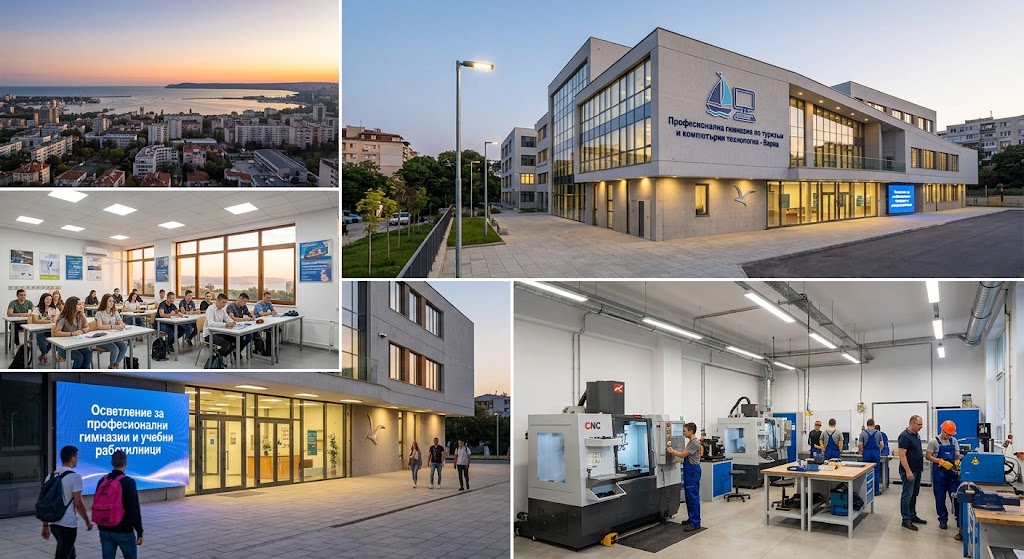
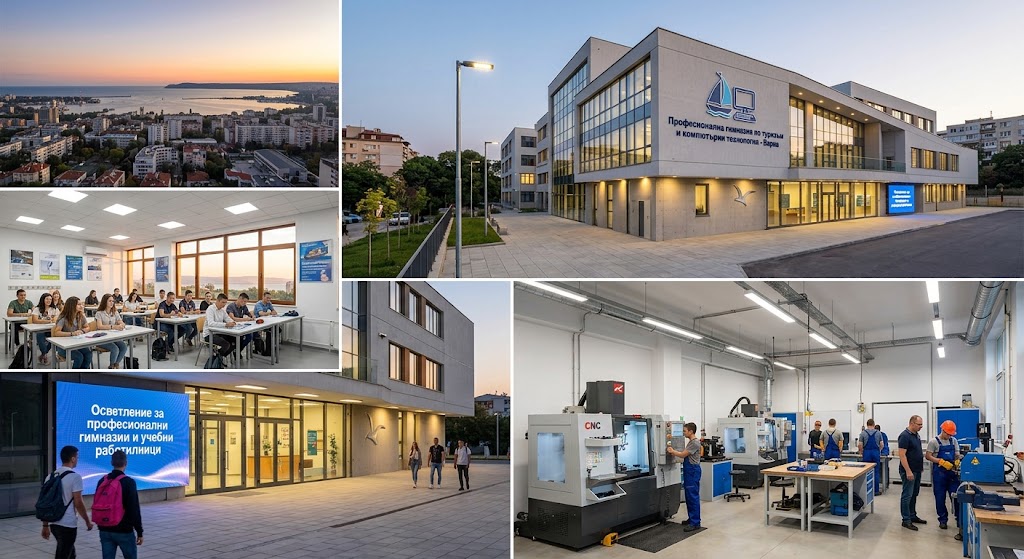
Lighting for vocational schools must combine the requirements of an educational environment with those of a real workplace. In technical classrooms, students read, draw and use displays, while training workshops contain machines, tools and materials where clear visibility is directly related to safe working conditions.
Teaching and production areas should therefore not use one identical lighting solution. The design needs to reflect the activities performed in each area, the position of workstations and machinery, required task illuminance, potential shadows and exposure to dust or mechanical impact.
The first step is to divide the facility according to its activities. A standard teaching area, technical classroom, demonstration station, laboratory, machine workshop and storage area involve different visual tasks.
EN 12464-1:2021 specifies 500 lx as the basic maintained illuminance for teaching workshops, together with good uniformity, colour rendering of at least Ra 80 and glare control. This should be treated as a starting point. Work involving small components, precision measurement, electronics, technical drawing or specific machinery may require higher illuminance or additional local task lighting.
In a technical classroom, lighting should support writing, reading, drawing, demonstrations and computer work. Uniform illumination, glare control and good visibility of work surfaces, display boards and demonstration areas are important.
In a workshop, attention shifts to the actual task area. Light needs to reach cutting, assembly, measuring and machining positions regardless of the arrangement of equipment. High floor illuminance is of limited value if a machine or the student's hands cast a shadow over the component being worked on.
A common design mistake is to arrange all luminaires in a regular ceiling grid without analysing the equipment below. Machine frames, covers, extraction systems and operators themselves can create strong shadows directly over the task.
A combination of general and local task lighting can solve this problem. General lighting provides uniform visibility and safe circulation, while a local luminaire delivers additional light to the specific operation.
Task lighting also needs to control reflections from metal components and tools. Where rotating machinery is used, the lighting design should consider how moving parts appear under the selected light source and control system, avoiding visual effects that could make motion more difficult to judge.
Ra, or the colour rendering index, indicates how naturally colours appear under a particular light source. In vocational education, this can be important when students need to identify cables, markings, electronic components, materials, coatings and other colour-coded elements.
Ra 80 is a baseline requirement for many educational and workshop activities. Courses in which colour forms an important part of the task, such as electronics, vehicle refinishing, design or surface inspection, may require higher colour-rendering performance according to the specific activity.
A technical workshop is not an ordinary classroom. Woodworking, metalworking and other practical activities may generate dust and particles, while tools and materials can increase the risk of accidental mechanical impact. Luminaire construction should therefore match the actual working environment.
The IP classification describes protection provided by the enclosure against the ingress of solid objects and water, while the IK code describes resistance to external mechanical impact. The required ratings depend on the workshop, cleaning method, mounting position and likelihood of contact with tools, materials or equipment.
Protected industrial luminaires may be appropriate in demanding areas, but there is no reason to apply the same specification throughout the entire school. Teaching classrooms and production-style zones should each use solutions selected for their particular conditions.
Emergency lighting must allow occupants to leave safely if the normal lighting supply fails. Escape routes, exits, stairs, changes in level and fire-safety equipment need to remain identifiable.
EN 1838:2024 specifies a minimum horizontal illuminance of 1 lx for escape routes. High-risk task areas have different requirements. Emergency lighting in these areas should allow a potentially dangerous process to be shut down safely, with the standard specifying 10% of the normal task illuminance and a minimum of 15 lx.
This can be particularly relevant where workshop machinery or processes cannot simply be abandoned when the normal lighting fails. Whether high-risk task lighting is required should be established through a risk assessment of the particular equipment and activity.
A vocational school should be treated as a combination of educational and technical working environments. Photometric design establishes the lighting required for each activity, identifies shadow and glare risks and allows different luminaires, optical systems and protection levels to be specified for classrooms and workshops.
Polaris Lighting provides lighting design and solutions for vocational schools, technical classrooms and training workshops, including general, task, protected and emergency lighting. Contact us if you need a lighting solution designed around the educational activities, equipment and working conditions of your facility.
