Lighting solutions
en

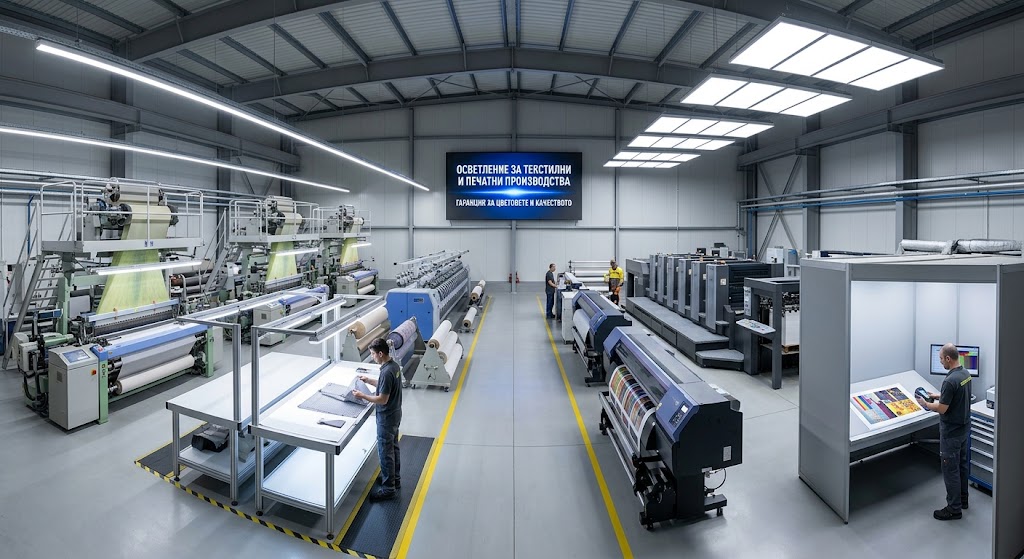
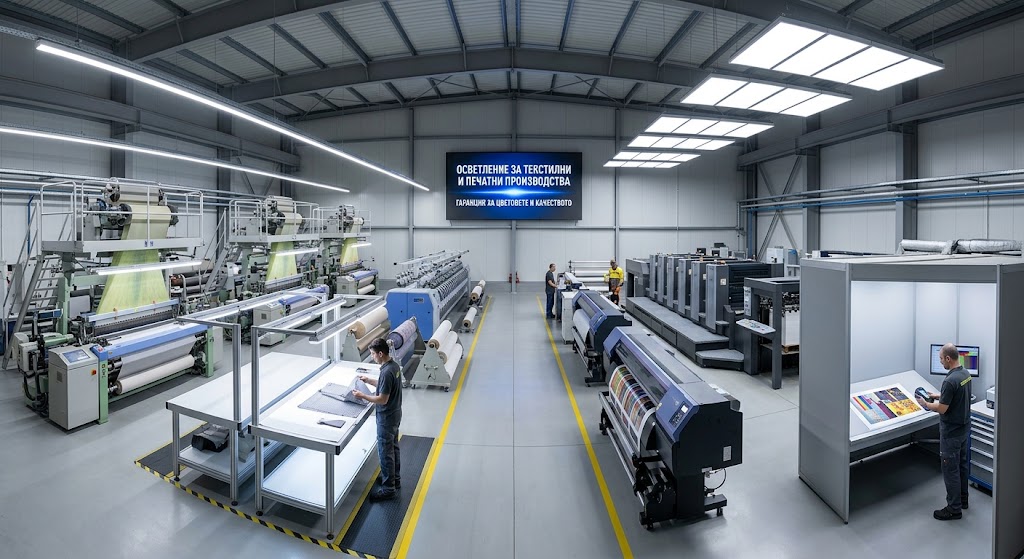
Lighting for textile and printing facilities must support reliable recognition of colours, defects, patterns, textures and small details during extended working periods. Production machinery, sewing or prepress workstations, visual inspection areas and warehouses therefore should not all use the same lighting solution.
Colour rendering, uniformity, shadows and temporal light modulation require particular attention. Where rollers, spindles, printing cylinders and other components are moving rapidly, unsuitable LED lighting can reduce visual comfort and create undesirable stroboscopic effects.
The design process begins with the specific visual task. A textile machine operator, a printing press operator and a specialist comparing colour samples have very different requirements from the lighting system.
EN 12464-1:2021 treats these activities separately. In textile production, sewing and fine knitting require higher lighting levels than many general machine operations, while colour inspection and fabric control require 1000 lx and Ra 90. Colour inspection in multicolour printing is even more demanding, with 1500 lx, Ra 90 and a controlled colour-temperature range.
These figures should be treated as design requirements within the context of the actual process. Machine speed, detail size, worker age, surface reflectance and the effect of equipment on light distribution also influence the final solution.
In textile and printing operations, colour is often a product specification rather than simply an aesthetic consideration. If the lighting changes how a shade is perceived, identical samples may appear different or a genuine colour variation may go unnoticed.
Ra, or CRI, indicates how naturally colours are rendered by a light source. Ra 80 is suitable for many general production tasks, but EN 12464-1:2021 requires Ra 90 for critical colour inspection. Colour temperature also needs to be controlled in these areas so that comparisons take place under defined and repeatable viewing conditions.
Workstations where colour decisions are made should use coordinated lighting conditions. A sample approved under one type of light may otherwise appear different when moved to another inspection station.
An inspection station should reveal defects rather than simply provide a high illuminance value. Textile inspection may involve identifying irregular fibres, stains, structural defects or differences in dyeing. Printing inspection can involve registration, density, surface quality, image detail and colour variation.
Light direction is as important as light quantity. When checking texture, relief or surface defects, light arriving from an appropriate angle can reveal irregularities more clearly than completely diffuse illumination.
Critical inspection positions can therefore combine general lighting with dedicated local task lighting designed specifically for the inspection method.
Machinery, operator hands, rollers, arms and structural components can cast shadows directly onto the task area. A uniform ceiling grid does not automatically create uniform light on the actual working surface.
Photometric design should use the real equipment layout. Where necessary, additional task lighting can introduce light from another direction so that the worker does not create a strong shadow over the product being inspected or handled.
Textile and printing facilities frequently contain rapidly moving or rotating machinery. If light output varies over time, the apparent movement of these components can differ from their actual motion. This stroboscopic effect should be considered when selecting LED luminaires and drivers.
The European ecodesign framework uses PstLM as a metric for visible flicker and SVM for stroboscopic effects. For workplaces with continuous movement, the technical specification should consider these parameters and verify lighting behaviour under the actual operating conditions, including dimmed modes where applicable.
This is particularly important around rotating shafts, rollers and similar machinery. Lighting should not make movement more difficult to perceive correctly.
A very bright workstation surrounded by a much darker environment forces the visual system to adapt repeatedly. During long shifts this can create unnecessary visual discomfort.
The design should therefore consider not only the task area but also its immediate surroundings. Walls and other vertical surfaces contribute to the overall visual environment and should not remain unnecessarily dark in comparison with the working plane.
Storage areas do not automatically require the same colour rendering or illuminance as inspection stations. Their main tasks usually involve safe movement, product identification, label and batch reading and accurate order picking.
High-rack storage benefits from suitable vertical illumination so that markings remain readable at different levels. If incoming materials or samples are also compared by colour in the warehouse, that specific inspection position should receive its own lighting solution rather than relying on general storage lighting.
Effective textile and printing lighting starts by identifying exactly what needs to be seen and evaluated at each workstation. Illuminance, colour rendering, light direction, uniformity and LED performance around moving equipment can then be specified according to the actual process.
Polaris Lighting provides lighting design and solutions for textile and printing facilities, including workstations, production spaces, visual inspection areas and warehouses. Contact us if you need a lighting solution designed around the visual tasks and technological process of your facility.