Lighting solutions
en

 ```html
Lighting for specialist food stores has to present products naturally and attractively while providing good visibility at worktops and supporting the hygiene requirements of the premises. General lighting and product lighting should therefore be designed separately, with display cases, refrigerated areas and food-preparation points treated according to their specific functions.
General lighting provides orientation, safe circulation and sufficient visibility throughout the store. It should cover aisles, entrances, checkout areas and the places where customers read labels and compare products.
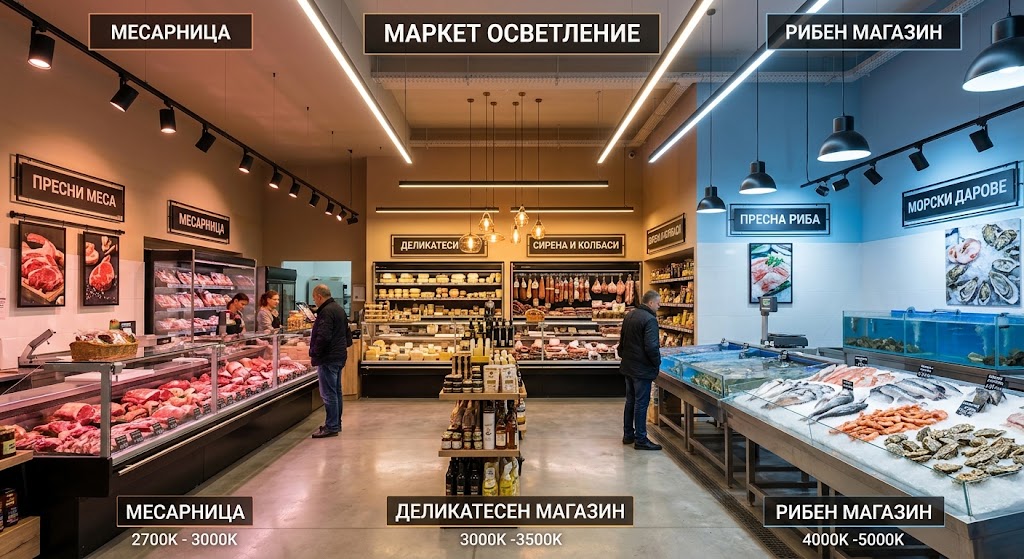
Product lighting serves a different purpose. It directs attention towards display cases, counters, shelving and individual food categories. Track spotlights, adjustable luminaires, linear systems or lighting integrated directly into display furniture can be used depending on the layout.
EN 12464-1:2021 specifies a baseline maintained illuminance of 300 lx for general retail sales areas and 500 lx for checkout and wrapping positions. The standard also specifically requires sufficient vertical illuminance on shelving.
A display case should be visually emphasised in relation to its surroundings without exposing customers to glare or creating strong reflections in the glass. The position and direction of the light can be just as important as the lumen output of the luminaire.
For meat, cheese, fish, pastries, prepared food and fresh produce, colour is an important part of visual assessment. Lighting should allow customers to identify food reliably. Codex Alimentarius states that, where necessary, lighting should not produce misleading colour.
This means that simply making a product appear brighter is not enough. Colour rendering, spectral characteristics and colour temperature should be selected according to the food category and the overall concept of the store.
EN 12464-1:2021 specifies a minimum colour rendering index of Ra 80 for general retail areas. In specialist food stores, higher colour-rendering performance can be appropriate in areas where the appearance of the food plays a significant role in the purchasing decision.
This is particularly relevant for fruit and vegetables, meat, fish, cheese, chocolate, pastries and prepared foods. Specialist food-retail LED solutions can also use different spectral distributions tailored to individual product categories.
Such solutions should be specified carefully. The objective is to reveal natural colours and textures rather than use light to give customers a misleading impression of the quality or condition of the food.
Behind the display counter there may be worktops used for cutting, packing, decorating, weighing or preparing products. Here the lighting is no longer primarily a merchandising tool. It becomes part of the daily working environment.
EN 12464-1:2021 specifies 500 lx for a number of critical tasks in food processing, including work in butcheries, delicatessen production and product inspection. For preparation and baking areas in bakeries, the baseline is 300 lx, while finishing and decorating tasks require higher levels.
The appropriate value for an individual store should be determined by the actual activity. Uniformity, shadows created by the worker and reflections from stainless-steel worktops, glass and equipment should also be assessed.
Refrigerated display cases and vertical chillers frequently contain integrated LED lighting. This should be coordinated with the general lighting of the store so that customers do not experience abrupt changes in colour appearance and brightness between adjacent product zones.
When luminaires are installed in a cold environment, the permitted operating-temperature range of the specific product should be checked. A luminaire and driver designed for normal retail-room temperatures should not automatically be assumed to be suitable for every refrigerated or low-temperature application.
Positioning also matters. Light should reach the food itself rather than being directed mainly onto doors or display glass, where it can produce distracting reflections.
Regulation (EC) No 852/2004 requires food premises to have adequate natural and/or artificial lighting and to be designed so that effective cleaning and hygienic operation are possible. In food-handling areas, luminaire construction therefore needs consideration alongside photometric performance.
Smooth surfaces, fewer locations where dust can accumulate and good access for cleaning simplify maintenance. Codex Alimentarius recommends that lighting fixtures should be designed and installed to minimise the accumulation of dirt and, where appropriate, should be protected so that food cannot be contaminated if a lamp or fixture breaks.
An IP rating may be important in areas exposed to moisture or particular cleaning procedures, but the required level of protection should be selected according to the actual conditions at each location.
A butcher shop, bakery, cheese shop and delicatessen should not be illuminated using one universal template. The lighting design starts with the store layout, the products being sold, display-case construction, work activities and cleaning procedures. Optical distribution, colour rendering, output and luminaire positions can then be selected for each individual zone.
Polaris Lighting provides lighting design, photometric calculations and the selection and positioning of general, linear and accent lighting for retail and working environments. Contact us if you need lighting for a specialist food store.
```