Lighting solutions
en

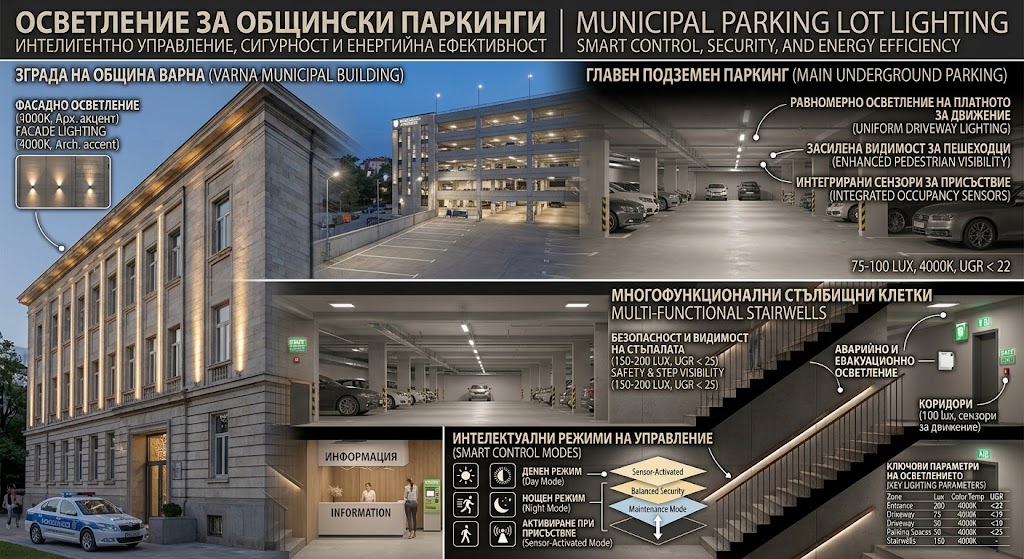
Lighting for outdoor municipal car parks should provide clear visibility for drivers and pedestrians, make entrances, barriers and routes easy to recognise and support the requirements of the surveillance system. A good design is not based on average illuminance alone. Uniformity, glare control, zoned control and the long-term durability of exterior luminaires are equally important.
Entrances, vehicle lanes, parking bays, pedestrian routes, barriers and payment or access points perform different visual tasks. The lighting design should therefore divide the site according to actual use before luminaire positions are determined.
EN 12464-2:2024 defines different baseline values according to traffic intensity. Parking areas with light traffic require 5 lx maintained average illuminance, medium-traffic parking areas require 10 lx and heavily used parking areas require 20 lx. The minimum uniformity U0 is 0.25 for all three categories.
For a municipal car park, the appropriate category should be selected according to actual traffic, location, operating hours and its relationship with other public facilities rather than simply the number of parking bays.
A car park with intense pools of light directly below columns and dark areas between them does not provide a good visual environment. Drivers repeatedly move between bright and dark areas, while pedestrians and obstacles can become more difficult to detect.
Photometric calculations should therefore verify average illuminance, minimum values and uniformity across the complete usable area. The model should include column height, spacing, luminaire optics, site boundaries and surrounding illuminated areas.
At the entrance, drivers may need to identify the direction of travel, a barrier, signage, ticket machine or access information. Where a display, keypad or other interface is used, its readability should be checked from the normal position of the vehicle.
Directing a powerful floodlight towards approaching vehicles is not a good solution. It can create glare for the driver and make conditions more difficult for an entrance camera. Controlled optical distribution should instead place light on the area where the visual task actually takes place.
The route from a parked vehicle towards a pavement, municipal building, public transport stop or other public facility should remain visually clear. EN 12464-2:2024 specifies 5 lx as the baseline maintained illuminance for walkways used exclusively by pedestrians.
Where pedestrian routes cross vehicle lanes, the conflict area requires particular attention. Lighting should help drivers notice pedestrians in time without introducing excessive brightness differences compared with the surrounding car park.
A security camera does not perceive the car park in exactly the same way as the human eye. Vehicle headlights, very bright luminaires, deep shadows and high-contrast areas can all reduce the usefulness of recorded images.
Camera locations and operational requirements should therefore be known before the final lighting layout is fixed. Does the surveillance system only need to detect a person or vehicle, or is recognition or identification required? In the latter case, light direction, vertical visibility and the characteristics of the selected camera become important alongside illuminance.
Luminaires should not shine directly into camera lenses. Entrance areas should also be evaluated with vehicle headlights present because they can create significant contrast within the camera image.
Car parks with low or variable night-time occupancy can use zoned control. During quiet periods, the system can operate at a predetermined standby level and increase output in a local area when a vehicle or pedestrian is detected.
DALI-2 supports occupancy sensors and light sensors as standardised input devices. Their information can be used by a lighting-control system to react to movement, presence or available ambient light.
The reduced mode should still preserve suitable orientation and support surveillance requirements. Completely switching off large areas is not automatically the best strategy for a public car park.
Outdoor luminaires operate throughout the year and can be exposed to rain, dust, temperature variations, UV radiation and mechanical impact. Wattage and lumen output are therefore only part of the specification.
EN 12464-2 uses maintained illuminance values. The lighting calculation therefore needs to account for light-output depreciation and the accumulation of dirt over time. For a municipal facility, service access, cleaning intervals and replacement of failed components should also form part of the design strategy.
Polaris Lighting provides lighting design, photometric calculations, selection and positioning of exterior luminaires and sensor-based lighting-control solutions. Contact us if you need a lighting project for an outdoor municipal car park.
```