Lighting solutions
en

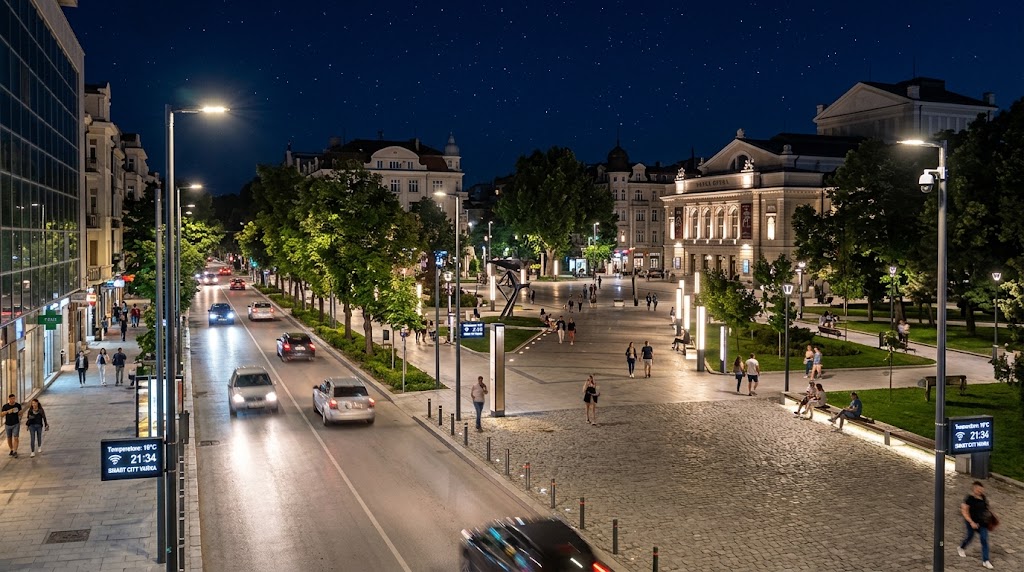
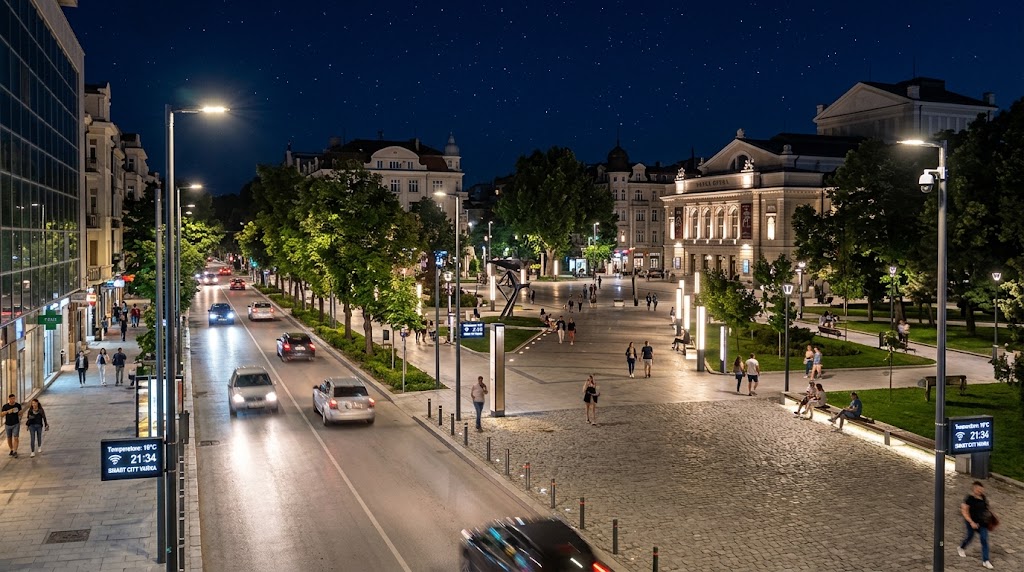
Lighting for municipalities and municipal companies involves much more than replacing old lamps with LED luminaires. Streets, parks, public buildings, façades and emergency routes create different lighting tasks and should be treated accordingly.
Polaris Lighting can support a project from the analysis of the brief and photometric calculations through technical specification, supply and after-sales support. For larger programmes, different areas and lighting categories can be organised in stages according to the agreed budget, implementation programme and municipal priorities.
For a modernisation project, the starting point is understanding the existing installation and the required result. An initial technical analysis can use available drawings and specifications, luminaire types, power ratings, positions, mounting heights, the condition of individual areas and the requirements defined by the client.
The objective should not automatically be to replace every existing luminaire with a new one in exactly the same position. The original layout may provide unsuitable distribution or use more fittings than a properly designed modern solution requires.
A photometric calculation shows how a specific luminaire will perform within the actual geometry of a street, pathway or public space. Mounting height, pole spacing, area width, luminaire position and light distribution are all taken into account.
Different outputs and optics can then be compared and the required lighting levels and uniformity can be verified. Selection is therefore based on the actual result rather than wattage or lumen figures alone.
A main urban road, residential street, junction and car park do not require the same lighting solution. Street projects need suitable light distribution, output, mounting height and spacing for the specific infrastructure.
Polaris Lighting offers LED street lighting for different urban and road applications, including products with IP65/IP66 protection. LDT/IES, BIM and 3D files are available for selected ranges to support professional project documentation.
Lighting in parks has a different role. It should support movement along paths, steps and entrances while preserving the character of the surrounding landscape.
Solutions can include park columns, low-level luminaires and focused lighting for individual architectural or landscape features. Optics, mounting height, weather protection and unwanted spill outside the intended area all need to be considered.
Municipal offices, cultural venues, sports facilities and other public buildings may require separate architectural façade lighting. Its role is to reveal important elements without unnecessarily illuminating the sky, windows or neighbouring properties.
Accurate optics and positioning are more important than simply increasing output. Suitable controls can also provide different evening operating levels or scenes for official events.
Solar luminaires can be considered where installing a new electrical cable route would be difficult or disproportionately expensive. Possible applications include individual paths, park areas and peripheral locations where local conditions are suitable for solar operation.
They should not be selected solely because no grid connection is available. Required illumination, autonomy, location, shading and operating profile all need to be assessed as part of the project.
Municipal offices, cultural and sports venues and other public facilities require separate emergency and escape lighting. Its purpose is to maintain orientation and visibility of escape routes and exits if the normal lighting supply fails.
Polaris Lighting offers emergency LED luminaires and exit signs together with technical documentation for professional lighting projects.
A clear specification allows the municipality, designer, contractor and supplier to compare the same technical requirements. Depending on the project, it can define:
This also provides a clear basis for assessing technical equivalents when substitutions are required, rather than comparing products only by price.
A project covering several districts, parks or public buildings does not necessarily require the complete lighting package to arrive at once. Supply can be organised around the agreed implementation sequence and project schedule.
Polaris Lighting organises project deliveries and provides its own transport for B2B customers. The logistics can therefore be coordinated with the specific project requirements, quantities and product availability.
A municipal lighting installation continues operating for years after the initial project has been completed. Access to technical documentation, warranty support, components and servicing therefore matters alongside initial efficiency and purchase cost.
Polaris Lighting provides its own after-sales support and remains available for technical assistance following project completion.
Street, park, façade, emergency and solar lighting serve different purposes, but they can form part of one coordinated municipal programme. Each area should receive a solution based on its actual requirements and verified through technical data and photometric calculations rather than applying one luminaire type everywhere.
Polaris Lighting provides lighting design and project supply for municipalities and municipal companies, including technical analysis of the project brief, photometric calculations, street, park, façade, emergency and solar lighting, technical specifications, project logistics, own B2B transport and after-sales support. Contact us if you need a lighting solution for municipal infrastructure or a public facility.
