Lighting solutions
en

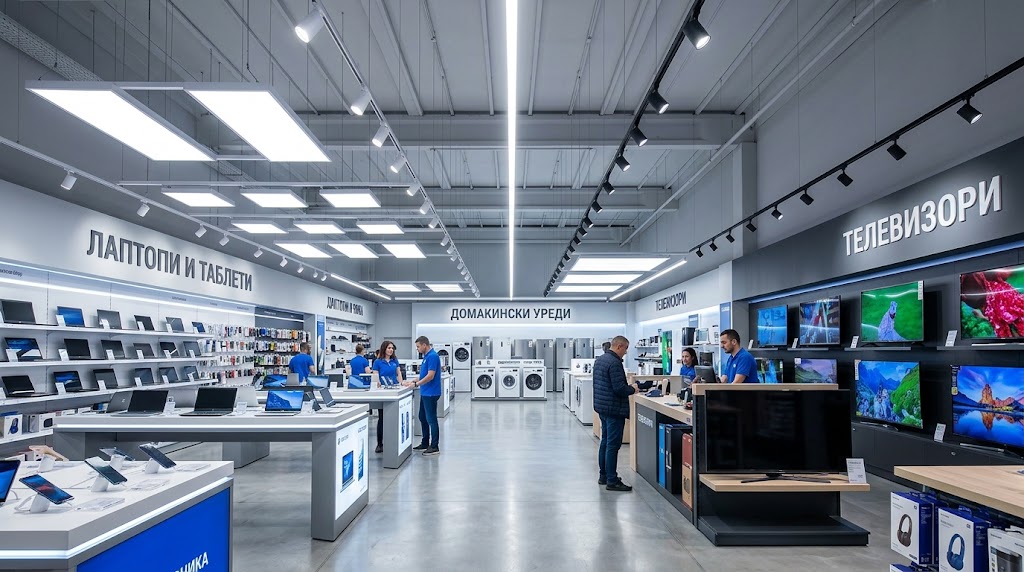
Lighting for electronics stores has to make products easy to see without creating distracting reflections on televisions, monitors, laptops and other glossy surfaces. An effective concept combines general, linear and track lighting according to the function of each area rather than illuminating the entire store in the same way.
An electronics store contains several very different visual tasks. Customers need to scan shelves, read small price and specification labels, compare operating screens and inspect demonstration products. Employees work at checkout counters, service desks and storage areas.
The lighting design should therefore begin by dividing the store into functional zones. Main aisles, shelving, wall displays, demonstration tables, television and monitor areas, checkout counters and storage rooms should be assessed separately.
EN 12464-1:2021 specifies a maintained illuminance of 300 lx for general sales areas and 500 lx for checkout areas. These values provide a starting point, but illuminance alone does not define good retail lighting. Uniformity, glare control, vertical illumination and the position of luminaires in relation to merchandise are equally important.
The main visual surface of a shelving system is vertical. If luminaires are selected only according to illuminance on the floor, products on upper and lower shelves can remain comparatively dark.
The lighting calculation should therefore examine how much light reaches the shelf face. Suitable light distribution makes products, packaging and price labels visible across the complete shelving system without creating a bright aisle surrounded by dark merchandise.
Televisions, monitors, laptops, tablets and smartphones present a specific lighting challenge. Their screens can reflect bright luminaires and other high-luminance surfaces within the store.
A spotlight or linear luminaire should therefore not be positioned only according to the ceiling layout. The design should consider whether the light source is visible as a reflection from normal customer viewing positions. Appropriate optics, mounting positions, aiming angles and controlled luminaire brightness can reduce both direct and reflected glare.
Long television display walls need particular attention. Vertical illumination should make the complete product area visible without becoming so bright that reflections compete with the images shown on the screens.
Tables displaying smartphones, laptops, gaming equipment, smart devices or small appliances should be visually distinct from the surrounding circulation areas. Track systems with adjustable spotlights are well suited to this task.
The main advantage of track lighting is flexibility. When merchandising changes, spotlights can be moved or redirected towards new products without redesigning the main electrical installation.
Accent lighting still requires precise control. An excessively narrow or intense beam can create distracting highlights on glass, metal and glossy plastic instead of improving the presentation of the product.
Linear LED systems are particularly suitable for main aisles, large open sales floors and long rows of shelving. They can create continuous lines of light and provide consistent illumination over large areas.
With suitable optical distribution, a linear system can illuminate both circulation areas and vertical shelving surfaces. This makes it particularly useful in stores with repetitive modular layouts and long merchandise aisles.
General lighting provides the basic light level for orientation and safe movement around the store. It can be created with linear systems, recessed or surface-mounted luminaires, downlights or a combination of several types.
The aim is not to make every part of the store equally bright. General lighting should form a comfortable visual background while track spotlights and specialised systems create emphasis around important products and display areas.
Customers in electronics stores frequently compare similar models according to price, capacity, screen size, power or other technical specifications. Clear illumination of price labels and product information is therefore a functional part of the store design.
Labels should not be hidden in shadows from the shelf above or produce strong reflections that make text difficult to read. This is particularly relevant for electronic shelf labels and glossy specification cards.
Checkout staff work for extended periods with monitors, payment terminals, barcodes, documents and merchandise. EN 12464-1:2021 specifies 500 lx for checkout areas and calls for stricter glare control than in the general sales area.
Bright luminaires should therefore be kept out of the employee's normal field of view and reflections on checkout displays should be minimised. The lighting should support visual tasks without creating additional visual strain.
In storage areas, the priorities are product and barcode identification, safe movement and adequate illumination of shelving. Ceiling height, aisle width and storage layout determine the appropriate luminaire positioning and optical distribution.
Areas that are occupied only periodically can also use presence detection or zoned lighting control. This allows lighting to operate where it is actually required while maintaining the functionality of the warehouse.
The most effective solution is usually not a choice between track, linear and general lighting. It is a coordinated combination of the three, based on how customers view, test and compare the products.
The design process starts with architectural drawings and the planned locations of shelving, demonstration tables, checkout counters and storage areas. Photometric calculations are then used to select luminaires and optics, verify illuminance and uniformity and identify positions where direct or reflected glare may occur.
Polaris Lighting provides lighting design, photometric calculations, selection and positioning of track, linear and general lighting systems, supply and technical support during implementation. Contact us if you need a lighting project for an electronics store.
