Lighting solutions
en

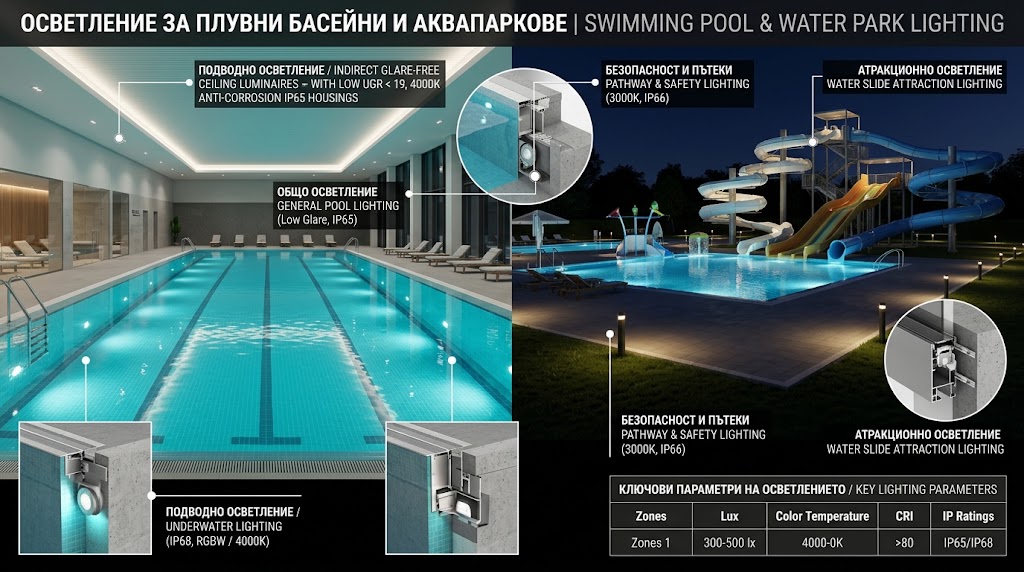
General and decorative lighting for swimming pools and water parks should provide clear visibility around water, safe movement across wet circulation areas and a comfortable atmosphere without excessive reflections or glare. Poolside areas, changing rooms, landscaped spaces and façades perform different lighting tasks, so functional and decorative lighting should be designed separately according to the actual operating environment.
General lighting provides visibility along main circulation routes, around pools, at entrances and within changing and service areas. It should allow visitors to identify flooring, steps, changes in level and other people clearly.
Decorative lighting has another purpose. It can highlight vegetation, façades, water features and architectural details and create different night-time atmospheres. It should not replace functional illumination in areas where continuous visibility is required for safe movement.
Swimming pools are treated as special locations within electrical installation standards. IEC 60364-7-702 specifically covers pool basins and their surrounding zones because the presence of water increases electrical safety risks.
It is therefore not sufficient to specify every luminaire simply as “water-resistant”. Its exact position in relation to the pool, exposure to splash or direct water, cleaning methods and the electrical requirements of the corresponding zone need to be established first.
The IP classification defined by IEC 60529 describes enclosure protection against the ingress of solid particles and water. The appropriate rating depends on the application. A façade luminaire, a fitting beneath a canopy and equipment positioned close to the pool can require different specifications.
A water surface acts as a large reflector. Poorly positioned floodlights can produce bright reflected images precisely in the viewing direction of visitors or staff looking across the pool.
Control begins with luminaire position and optical distribution. Light should reach the required area from suitable angles without placing high-luminance sources directly within normal viewing directions or dominant reflections from the water.
Photometric calculations can verify illuminance and uniformity around the pool, while the design should also consider actual viewing directions from loungers, pathways, lifeguard positions and seating areas.
Around wet surfaces, pool edges, steps, ramps and level changes should remain clearly visible. Bright pools of light separated by darker areas are not a good solution even if the calculated average illuminance appears sufficient.
Uniform lighting reduces abrupt changes in brightness and supports visual orientation. Sports pools and facilities intended for organised competition may also fall within the relevant requirements of EN 12193 according to the sport and competition level. Compliance with a specific competition class should only be confirmed through calculations for the individual venue.
In changing rooms, the main requirement is clear general visibility when dressing, using lockers and moving between wet and dry areas. Luminaires should be positioned so that open locker doors and users themselves do not create large shadows.
EN 12464-1:2021 treats changing facilities as separate service spaces. Alongside the required illuminance, the design should assess uniformity, glare and the suitability of luminaires for the moisture and cleaning conditions present in the room.
In water parks, a significant part of the visitor experience extends beyond the pool itself. Paths, vegetation, seating areas, entrances and façades can be treated as separate lighting layers.
Paths benefit from uniform functional illumination, while vegetation and architectural features can use controlled spotlights, low-level landscape luminaires and wall-washing solutions. Façade lighting can become part of the identity of the complex and can operate in different evening or event scenes.
Outdoor decorative light should remain focused on the intended surface. CIE guidance recommends controlling unwanted light towards the sky, neighbouring properties and other areas that do not require illumination at the design stage.
EN 1838:2024 requires a minimum horizontal illuminance of 1 lx along emergency escape routes. Where open-area anti-panic lighting is required, the minimum illuminance in the core area is 0.5 lx.
In a swimming pool or water park, routes from poolside areas, changing facilities and other visitor spaces towards safe exits should be clearly defined. Decorative dimming, coloured scenes and night-time settings must not interfere with the required operation of emergency and escape lighting.
Polaris Lighting provides lighting design, photometric calculations, luminaire selection and positioning, exterior, landscape and façade lighting and emergency and escape lighting solutions. Contact us if you need a general and decorative lighting project for a swimming pool or water park.
