Lighting solutions
en

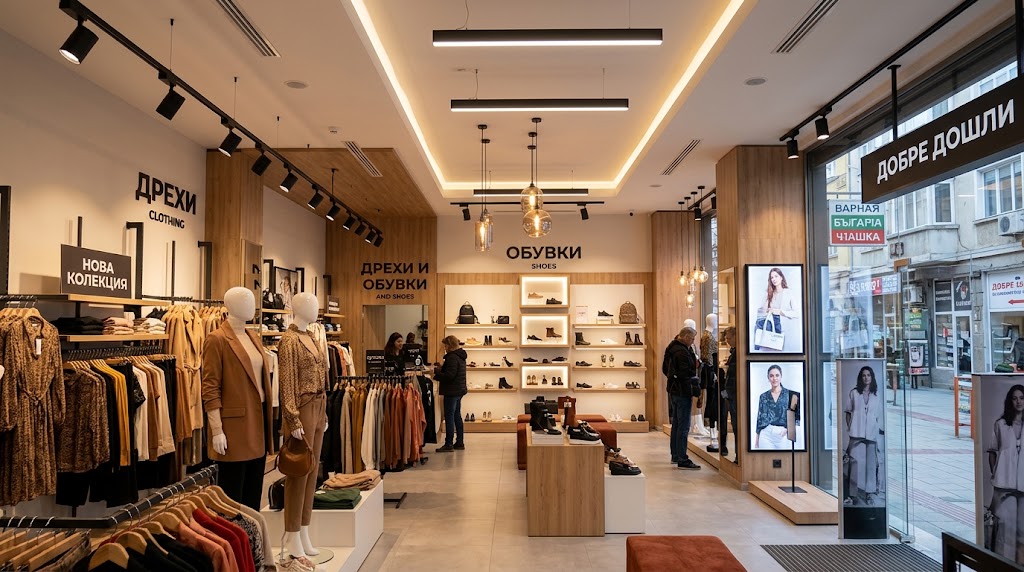
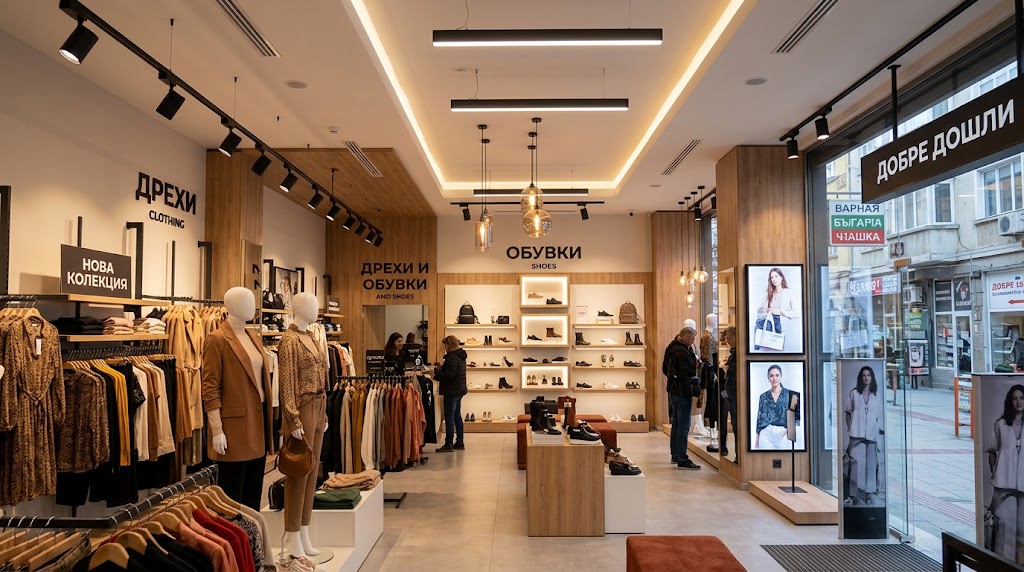
Fashion store lighting should combine comfortable general illumination with focused light that directs attention towards collections, mannequins, window displays and featured merchandise. Colour and texture also need to remain convincing throughout the customer journey, from the sales floor to the fitting room and mirror.
Uniformly bright lighting across the entire store is rarely the most effective solution. A more flexible concept combines general, vertical and accent lighting, with directional fixtures that can be repositioned whenever the merchandise layout changes.
General lighting provides orientation and comfortable movement between racks, shelving and merchandise tables. It should not be so dominant that every part of the shop appears equally important.
Accent lighting has a different role. It directs attention towards a new collection, promotional product, mannequin or architectural feature. Directional spotlights also model the shape and texture of garments through controlled highlights and shadows.
A practical design uses general lighting as a stable visual background while concentrating higher brightness on products and displays that need to attract attention.
Customers need to distinguish between closely related colours with confidence. Black and dark navy, different beige tones or subtle variations of red should not become difficult to differentiate under artificial lighting.
CRI, or Colour Rendering Index, is one parameter used to describe how naturally colours appear under a light source. For key fashion displays, fitting rooms and window displays, CRI/Ra 90 or higher can be an appropriate specification where accurate colour appearance is a priority.
CRI should not be considered in isolation. Colour temperature, optical distribution, surrounding materials and the contrast between general and accent lighting all influence the appearance of clothing.
A mannequin is a three-dimensional object and benefits from directional lighting that reveals both silhouette and textile texture. Strong light only from directly overhead can leave parts of the garment in shadow.
A spotlight with an appropriate beam angle can visually separate an individual mannequin from the background. Groups of mannequins may benefit from a broader distribution rather than several isolated narrow beams.
When mannequins move, the light should be able to move with them. This is one of the main advantages of track lighting compared with fixed spotlights.
The fitting room is where customers see the clothing on themselves and often make the final purchasing decision. A strong downlight directly above the head can produce deep shadows on the face and body and create an unflattering reflection in the mirror.
A softer and more even solution uses vertical illumination around the mirror. Light can be integrated beside the mirror or within surrounding architectural details to illuminate the face and clothing while reducing harsh shadows.
Colour rendering should remain consistent with the main sales floor. Clothing should not appear to change colour when the customer walks from a merchandise rack into the fitting room.
The window display needs to attract attention from outside and communicate the current collection. Stronger contrast and more dramatic accent lighting can be appropriate here than within the main sales area.
Mannequins and key products can be highlighted with narrow or medium beams, while wider or vertical lighting creates a calmer background. The combination adds depth and helps establish a clear visual hierarchy.
With glazed façades, reflections should be checked from the customer's position outside. A poorly aimed luminaire can become more visible in the glass than the clothing it is intended to highlight.
Fashion store layouts change frequently. Racks move, seasonal collections arrive, promotional tables are introduced and window displays are regularly rebuilt.
With a three-phase track system, spotlights can be moved, added and redirected towards new merchandise positions. Separate groups can also be independently controlled and, where the selected equipment supports it, incorporated into different lighting scenes.
A well-planned track infrastructure should not be designed around one collection. It should cover the areas where future racks, mannequins and promotional displays are realistically likely to appear.
With a flexible system, the process starts with the new merchandising layout. Once mannequins, racks and tables have been repositioned, the track spotlights can be moved and aimed towards the new focal points.
This avoids creating new electrical points whenever a seasonal collection changes. The permanent general lighting remains in place while the accent layer follows the merchandise.
Polaris Lighting provides lighting design, photometric calculations, luminaire selection and general, accent and track lighting solutions for fashion stores and boutiques. Contact us if you need lighting for sales areas, fitting rooms, mannequins, window displays or flexible seasonal merchandising layouts.
