Lighting solutions
en

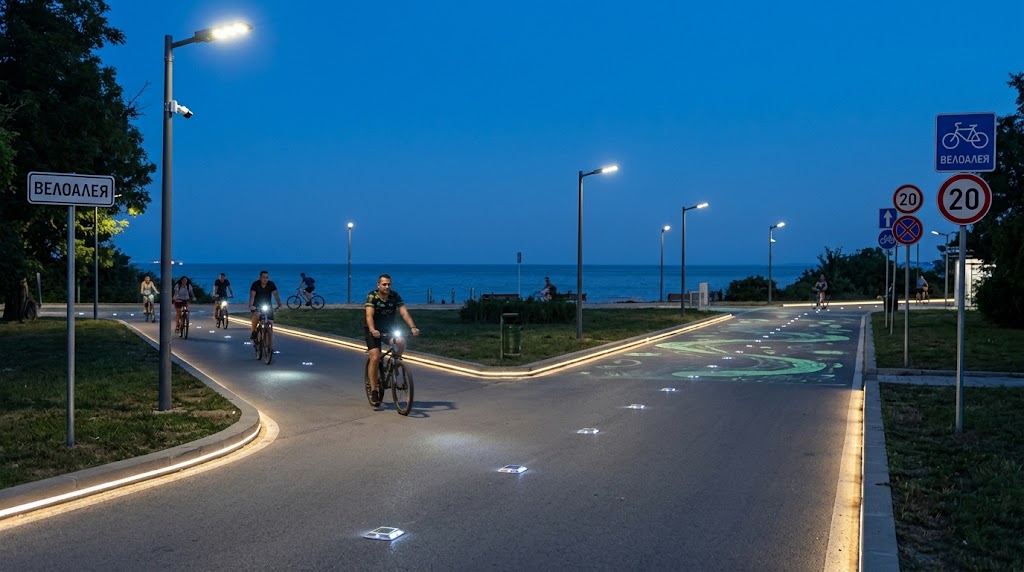
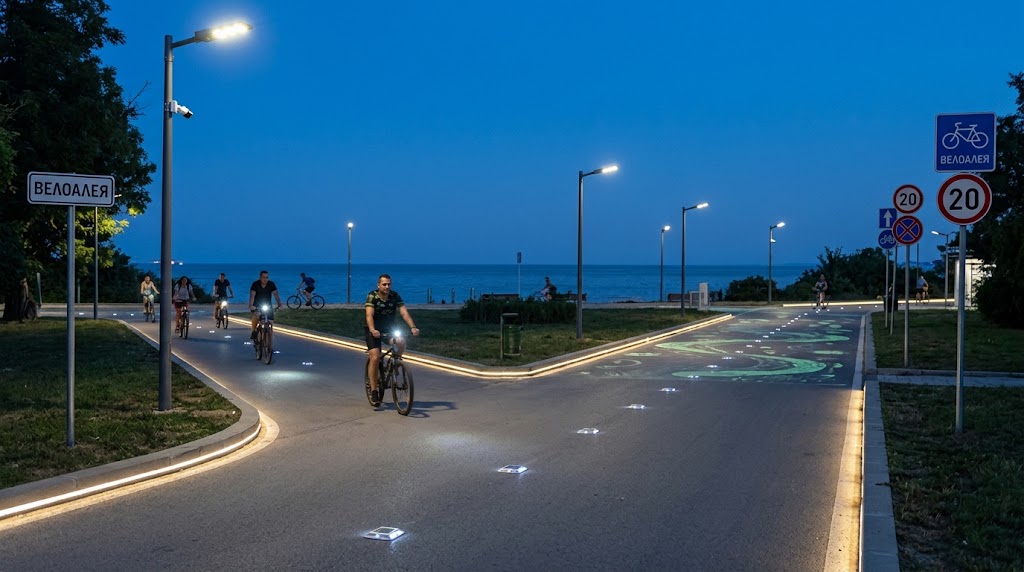
Cycle path lighting should give cyclists enough time to recognise the route ahead, surface conditions, bends, intersections, pedestrians and potential obstacles. A successful design is not about maximising light output. It requires suitable illuminance, good uniformity, controlled light distribution and limited glare throughout the route.
A cyclist travels faster than a pedestrian and therefore needs more distance to identify and respond to changes ahead. Lighting should provide continuous visual information rather than creating isolated bright areas separated by darker sections.
EN 13201-2 uses P classes for areas used by pedestrians and pedal cyclists, including cycleways. There is no single universal lux value for every cycle route. The appropriate lighting class depends on the location, traffic conditions, speed, surrounding environment and interaction with other road users.
Repeated movement between bright and dark sections forces the eye to adapt continuously. This can make surface defects, kerbs, branches or objects on the path more difficult to recognise.
Photometric design should therefore consider not only average illuminance but also minimum levels and the way light is distributed across the width and length of the route. Luminaire height, spacing and position need to work as one complete system.
Locations where a cycle path crosses a road, vehicle entrance, pedestrian route or another cycleway are visually more complex than uninterrupted sections. Cyclists need to see approaching vehicles and pedestrians, while other road users need to recognise the cyclist early enough.
Simply installing a higher-output luminaire over the crossing is not necessarily the best solution. Lighting should also improve vertical visibility of cyclists and pedestrians without producing an excessive brightness difference between the intersection and its approach.
At a sharp bend, the lighting should follow the direction of travel rather than continuing primarily along the previous alignment. Luminaire positions need to give cyclists advance visual information about where the route continues.
Narrow sections, islands, kerbs, barriers, trees and other fixed obstacles deserve particular attention. They should remain visible through suitable contrast against the background without placing bright sources directly in the cyclist's field of view.
A high-brightness LED source close to the line of sight can temporarily reduce the ability to see objects beyond it. This is particularly relevant for cyclists because their viewing direction changes continuously as they follow the route.
Solar luminaires can be useful where installing an electrical supply would be difficult or disproportionately expensive. Potential applications include park routes, peripheral paths and connections between developed areas.
A solar solution should not be selected from panel wattage alone. Local solar exposure, shading from trees and buildings, required autonomy, battery capacity, seasonal conditions and the actual operating schedule all need to be assessed.
For routes with consistently high usage or critical conflict points, the required light output and autonomy need to be demonstrated for the specific project. Solar lighting is not automatically a direct substitute for a grid-powered system.
A cycle path that is heavily used until 22:00 but sees little activity after midnight does not necessarily need to operate at the same output throughout the night. Where appropriate, lighting can be dimmed or controlled according to time and actual use.
Sensors and central control systems can maintain a lower background level and increase output as cyclists approach. The system needs to react early enough so that users do not ride toward sudden dark sections or experience distracting changes in brightness.
The process begins with route geometry, width, bends, intersections, changes in level, adjacent roads and expected traffic. The appropriate lighting class, luminaire positions, optical distributions and control strategy can then be established.
Photometric calculations are used to assess average and minimum illuminance, uniformity, potential glare and performance at critical locations. Where solar lighting is considered, the design also requires an energy-balance and autonomy assessment.
Polaris Lighting provides lighting design, luminaire selection and supply for cycle paths, including street, park, solar and controlled lighting systems. Contact us if you need cycle path lighting with good uniformity, controlled glare and a solution designed around the specific route and operating conditions.
