Lighting solutions
en

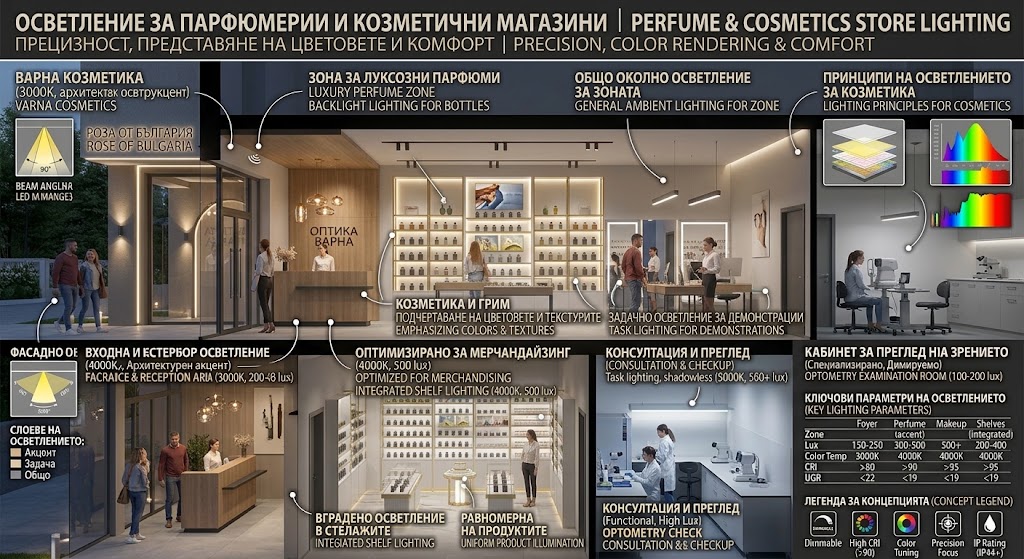
Cosmetics store lighting should allow customers to perceive make-up colours, packaging and their own skin naturally while highlighting merchandise and controlling reflections from mirrors, glass and glossy surfaces. General, product and testing-area lighting should therefore be designed as separate layers rather than using the same light throughout the entire store.
With foundations, lipsticks, eyeshadows, blushers and other colour products, small differences in shade are part of the purchasing decision. Lighting that alters colour appearance can make the same product look different at the display, at the testing table and later under natural light.
EN 12464-1:2021 specifies Ra 80 as the baseline requirement for general retail areas. In cosmetics retail, however, professional lighting practice commonly uses Ra above 90 in product and testing areas where realistic perception of product colours and skin tones is particularly important.
Ra alone should not determine the specification. Spectral characteristics, consistency between luminaires and colour temperature also need consideration. If a testing area has visibly different light from the product display, customers may perceive the same shade differently between the two locations.
Lighting that comes mainly from the ceiling can create pronounced shadows beneath the eyes, nose and chin. This is not ideal when a customer needs to assess a cosmetic shade on their own skin.
A better approach introduces soft vertical light from the front or sides of the mirror. This illuminates the face more evenly and allows products to be compared across different parts of the skin without large differences created by shadows.
Where several testing stations are installed, similar lighting conditions should be maintained between them. One position should not be illuminated by an intense spotlight while the neighbouring station is substantially darker.
Cosmetics stores contain many reflective surfaces, including mirrors, glass cabinets, metallic packaging, glossy furniture and polished displays. A high-luminance source in the wrong position can become more visually prominent than the merchandise itself.
CIE identifies glare as an important component of indoor lighting quality. The position and luminance of the light source should therefore be assessed from the normal viewing directions of customers, particularly around mirrors and testing counters.
Controlled optics, suitable shielding and precise aiming often improve visual comfort more effectively than simply changing the wattage. Around mirrors, the luminaire should not create a dominant bright reflection directly behind the customer's face.
Much of the merchandise in a cosmetics store is arranged vertically on shelving. Floor illuminance alone therefore provides an incomplete picture of how well customers can actually see the products.
EN 12464-1:2021 specifies 300 lx as the baseline for general sales areas and specifically requires sufficient vertical illuminance on shelves. Linear lighting, wall-washing solutions or adjustable spotlights can be used according to the design of the display furniture.
Uniform shelf lighting makes it easier to compare small packages and closely related shades. Separate accent spotlights can then be used for new collections, promotional areas or premium product ranges.
The testing area is where product presentation becomes practical evaluation. Customers examine texture, coverage and colour directly on their skin.
The light should be bright enough for detailed viewing without producing harsh shadows or distracting glare. The product and the customer's face should ideally be viewed within the same controlled lighting environment.
Larger stores can also incorporate defined lighting scenes or dedicated test positions. If different lighting conditions are intentionally demonstrated, they should be presented as clearly controlled modes rather than an accidental mixture of different colour temperatures.
Window-display lighting needs to distinguish the merchandise from its surroundings and reveal colours, shapes and textures clearly. Excessive brightness can increase reflections in the glass and actually make the display more difficult to see from outside.
Adjustable track spotlights are useful where campaigns change regularly. The light can be redirected towards new product compositions without rebuilding the complete installation.
Decorative lighting can highlight a brand wall, niche, promotional graphic or architectural feature. It should complement rather than replace functional illumination on merchandise and faces.
A practical lighting concept can combine uniform ambient light, vertical illumination for shelving, track spotlights for merchandise and dedicated lighting at mirrors and testing stations. This allows product categories to be visually differentiated without making the entire store uniformly and excessively bright.
Polaris Lighting provides lighting design, photometric calculations and the selection and positioning of general, linear and track lighting systems for retail environments. Contact us if you need a lighting project for a cosmetics store.
```