Lighting solutions
en

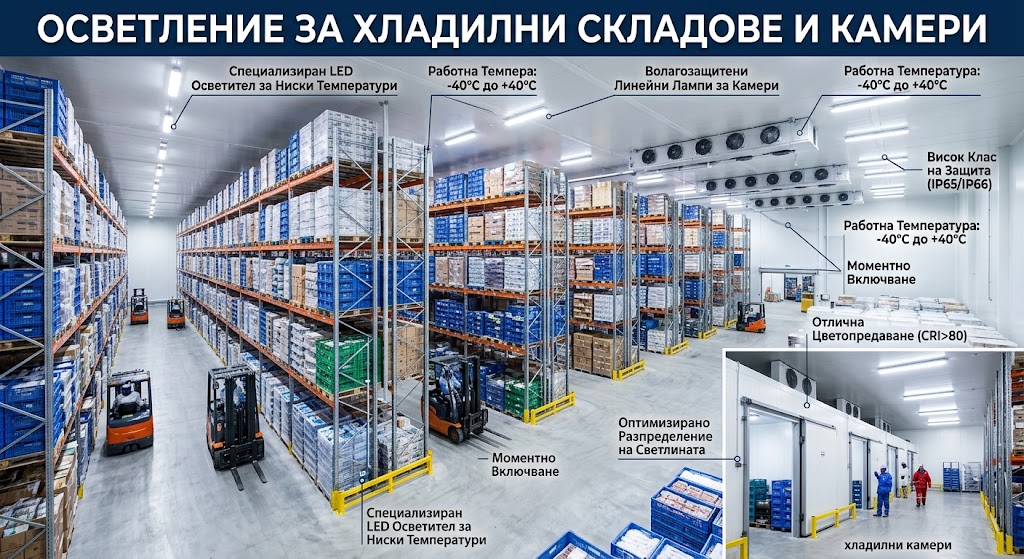
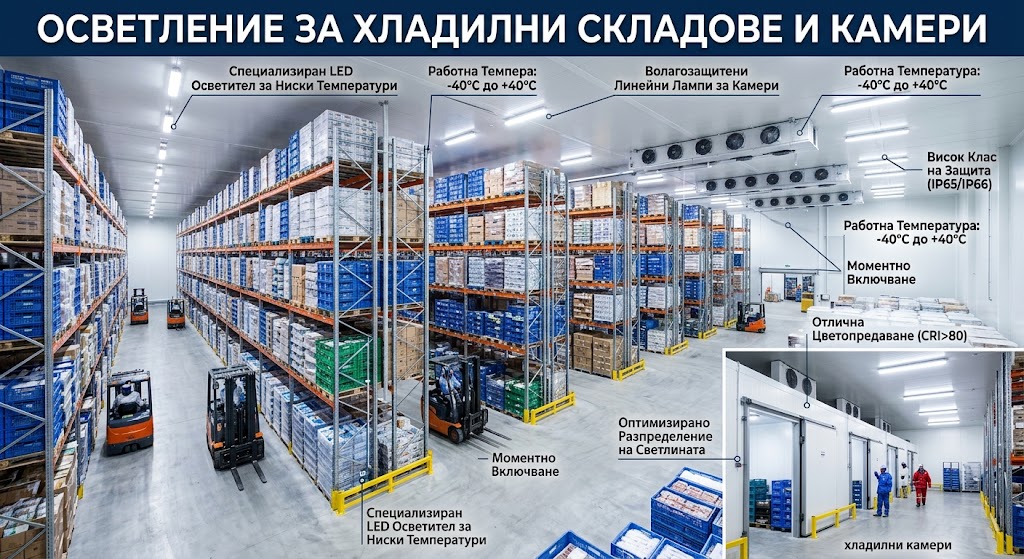
Lighting for cold and freezer warehouses must be designed not only around the required illuminance but also around temperature and operating conditions. At sub-zero temperatures, the luminaire, driver, sensors and emergency components need documented suitability for the environment and reliable operation at the lowest design temperature.
Selecting a product solely by wattage, lumen output or IP rating is therefore not sufficient. Product documentation, operating temperature, installation method, optical distribution and the conditions under which the manufacturer declares its performance all need to be checked.
A chilled warehouse and a deep-freeze room are not the same environment. One area may operate close to or slightly above 0°C, while another may remain well below freezing. A luminaire designed for an ordinary warehouse should not automatically be assumed to be suitable for a freezer.
The declared ambient operating range of the complete luminaire should be checked. The minimum permitted ambient temperature, often stated as Ta, is particularly important.
The driver, seals, cables, connectors and other components also need to be considered. The temperature limitation of one component may determine the operating limit of the complete lighting solution.
In areas where lighting is switched off for periods of time, reliable cold starting is an important requirement. It is not enough for a luminaire to continue operating after it has cooled if its electronics are not designed to start from a cold condition at the minimum room temperature.
Where occupancy controls create frequent switching, the permitted number of switching cycles, driver compatibility and the conditions under which these characteristics are declared should also be reviewed.
Moisture in a cold store is not determined only by its normal indoor conditions. Door opening, warmer incoming air, defrost cycles and cleaning can create condensation and significant temperature changes.
An appropriate IP rating is important but does not automatically address every issue associated with cold environments. Manufacturers may specify special seals, membranes or other construction details for cold-storage applications. These requirements should be confirmed in the documentation for the particular product.
Where areas are washed, the cleaning method, water exposure and cleaning agents should also be considered separately.
In high-rack warehouses, light needs to reach not only the floor but also the vertical faces of the racks. Labels, barcodes and stored goods should remain visible across the usable storage height.
Photometric calculations should therefore use the actual aisle and rack configuration. Narrow, high aisles may require more controlled optical distributions, while receiving, picking and open storage areas can require different optics.
Mounting height also affects luminaire quantity, output and position. Two luminaires with identical lumen output can produce substantially different results because of their different light distributions.
Intermittently occupied areas can benefit from presence-based lighting control. This can reduce operating hours and also limit unnecessary heat introduced into a refrigerated space.
The sensor itself, however, must be suitable for the temperature. Its operating range, mounting height, detection area and compatibility with the selected LED drivers should all be checked.
In high-bay aisles, detection should be planned so that the lighting responds before a person or vehicle has travelled into an inadequately lit section.
Escape routes, exits, intersections and other required emergency areas need to remain identifiable if the normal lighting supply fails. Emergency lighting should be designed separately according to the applicable requirements and the actual escape-route layout.
Where self-contained emergency luminaires or emergency modules are installed inside a freezer, the operating temperature of the battery and associated electronics must also be verified. If these components are not rated for the room temperature, another technical approach should be specified.
For refrigerated and freezer applications, a specification should require concrete technical evidence rather than a general description such as “industrial luminaire”. Relevant information includes:
Polaris Lighting offers industrial lighting solutions with published technical characteristics and LDT/IES documentation, including products identified for cold-storage applications. Suitability should nevertheless be verified for the specific model, configuration and design temperature of each project.
A reliable design requires the warehouse layout, minimum and maximum temperatures, mounting heights, rack configuration, work areas, escape routes and control strategy. Photometric calculations can then be completed and luminaires selected whose documentation demonstrates suitability for the actual operating conditions.
Polaris Lighting provides lighting design and supply for cold and freezer warehouses, including photometric calculations, industrial luminaires, lighting controls and emergency lighting. Contact us if you need lighting design and supply for a cold or freezer warehouse.
