Lighting solutions
en

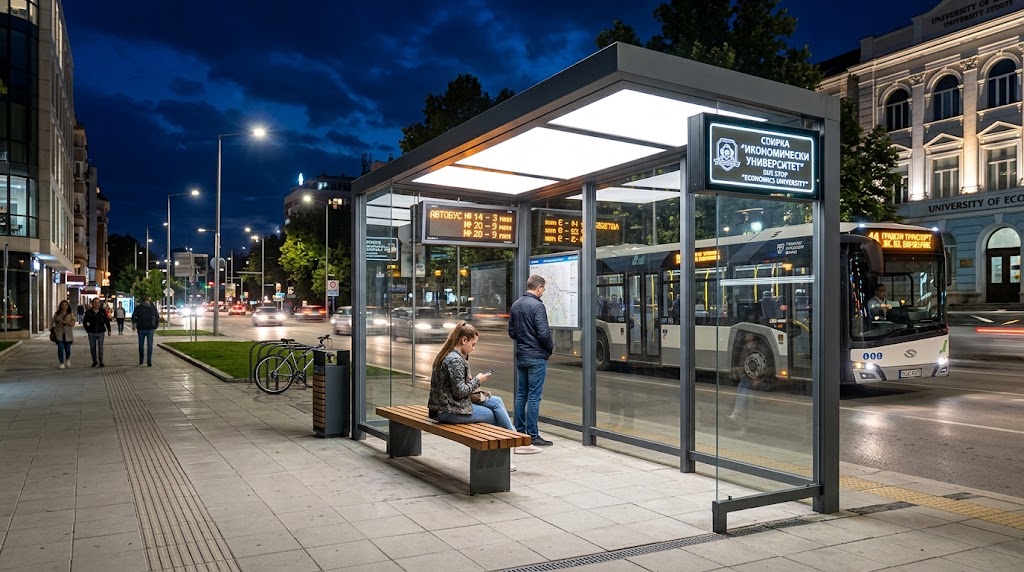
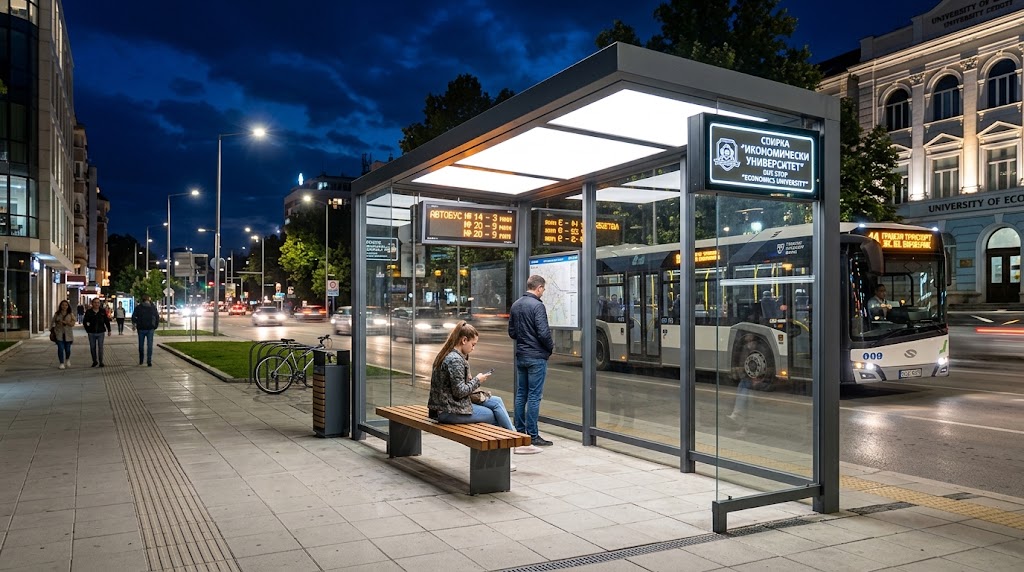
Bus stop lighting should help passengers locate the stop, read service information, wait comfortably and move towards the bus with clear visibility after dark. The design therefore needs to consider the shelter together with pedestrian approaches, the kerb, passenger information and the surrounding street environment.
The appropriate solution depends on the location, passenger demand, available electrical infrastructure, shelter construction and existing street lighting.
Lighting inside the shelter should make passengers, seating and the available waiting space clearly visible without placing a bright source directly within the normal field of view. Excessive brightness inside an otherwise dark environment can make it harder to see beyond the shelter.
Glazed shelters also require reflection checks. A luminaire may appear correctly positioned on a drawing but create reflections in the side panels that interfere with views towards the road or an approaching bus.
Passenger information is one of the primary functional elements of a bus stop. Lighting needs to reach route maps, timetables and stop information without forcing the passenger to stand between the light source and the display.
Where digital information screens are used, ambient light should also be checked for reflections and excessive contrast. General lighting should support information visibility rather than compete with the display.
Advertising panels may be unlit, externally illuminated or equipped with integrated LED lighting. In each case their brightness should be considered in relation to the functional lighting of the stop.
If the advertisement becomes substantially brighter than the waiting area and timetable, it can dominate the visual environment. Functional and advertising lighting are therefore better designed as parts of one system rather than two independent installations.
A brightly illuminated shelter is not sufficient if the immediate route towards it remains dark. Connections with footways, level changes, steps and the transition between street lighting and the stop itself should all be reviewed.
This is particularly relevant to stops beside parks, peripheral roads or locations with limited surrounding lighting. A separate luminaire for the approach may be more effective than expecting a shelter-mounted fixture to illuminate the entire area.
The space between the waiting position and the bus door needs to remain visually clear. Kerbs, edges and changes in level should not disappear into deep shadows.
At the same time, the lighting should not create distracting glare for approaching drivers. Luminaire position and optics should therefore be evaluated from both the passenger viewpoint and the direction from which buses enter the stop.
Where suitable electrical infrastructure already exists, a mains-powered system provides a continuous energy supply and can simplify the integration of additional loads such as illuminated passenger information or advertising panels.
Solar lighting can be useful where extending the electrical network would be difficult or disproportionately expensive. It may suit peripheral stops, interurban locations and isolated sites without an accessible grid connection.
A solar system needs to be assessed according to more than LED wattage. Panel position, shading, required operating hours, battery capacity and winter conditions all affect performance. The system should therefore be sized for the specific site and operating profile.
Bus stop equipment is exposed to rain, dust, condensation and changing temperatures throughout the year. The required IP rating should be selected according to the actual position of the luminaire and its level of exposure.
Mechanical resistance is also relevant in public infrastructure. The IK classification describes the degree of protection provided by an enclosure against external mechanical impact. Mounting methods, exposed fixings and access to cabling should also be considered when evaluating the installation.
A robust housing is only one part of the solution. Luminaires, batteries, drivers and cables should be positioned so that they cannot be easily reached or removed without appropriate service tools.
Compact construction, concealed wiring and modular components can make intentional damage more difficult while simplifying future maintenance. If one component fails, being able to replace it without dismantling the complete shelter is particularly valuable across a large network of stops.
A successful lighting design connects the shelter, passenger information, advertising, pedestrian approach and boarding zone into one coherent system. The choice between mains and solar power follows an assessment of the site, while optics, luminaire positions and protection levels are selected for the individual stop.
Polaris Lighting provides lighting design and lighting solutions for bus stops and the surrounding urban environment, including photometric calculations, street and solar lighting and technical selection of suitable exterior luminaires. Contact us if you need lighting design or project supply for bus stops.
