Lighting solutions
en

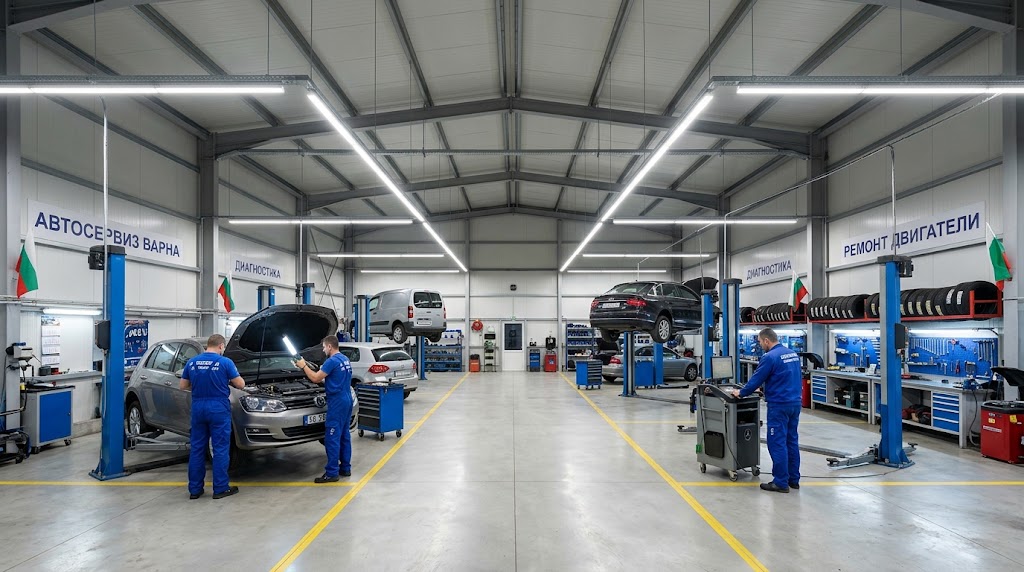
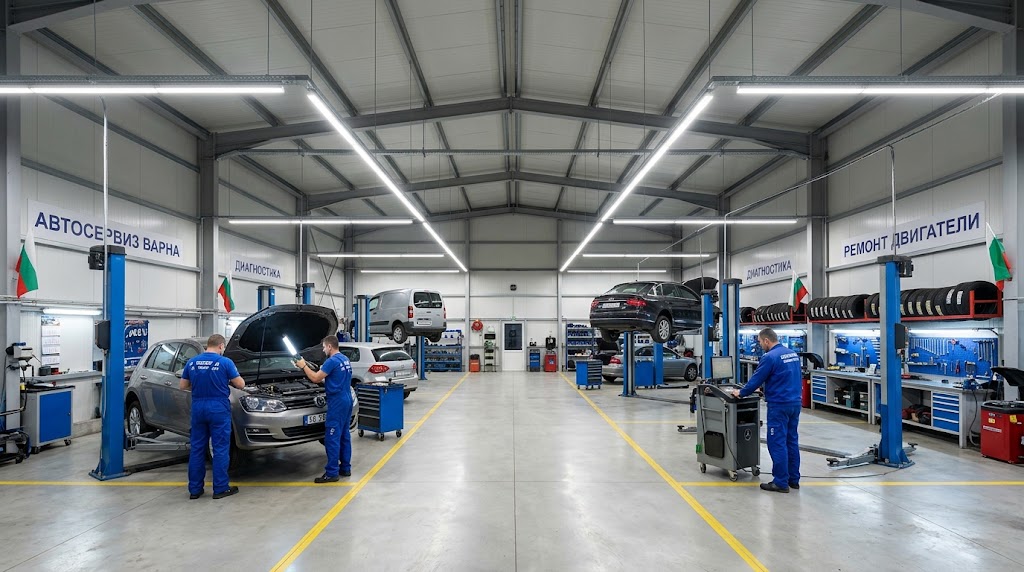
Auto repair shop lighting should provide uniform visibility around the vehicle, enough light for detailed tasks and reliable operation in areas exposed to dust, moisture, oils and mechanical stress. The best approach is separate planning for vehicle lifts, inspection pits, diagnostic bays, storage, reception and outdoor zones.
An automotive workshop combines visual inspection, mechanical repair, under-vehicle work, diagnostics, vehicle and pedestrian movement and parts storage. Lighting therefore has to be designed around the task performed in each area, not only around the floor area.
EN 12464-1:2021 specifies 500 lx maintained illuminance for general vehicle servicing, repair and testing, with minimum uniformity Uo 0.60, colour rendering Ra 80 and UGRL 22. Tasks involving small details or difficult-to-reach components also require suitable local task lighting.
Ceiling lighting alone is rarely enough once a vehicle is raised. The body and lift structure create shadows exactly where the technician needs to work. General lighting should therefore be supplemented with linear or local technical luminaires positioned to illuminate the sides and underside of the vehicle without creating strong glare.
Fixtures around lifts should withstand accidental impact. Where luminaires are mounted close to the floor or near wash-down areas, moisture and water splash also have to be considered.
A diagnostic bay needs good ambient visibility and effective light for engine compartments, wheels, brakes, test equipment and screens. Bright reflections on displays and glossy surfaces should be controlled. Uniform ambient lighting combined with focused local light usually works better than simply increasing ceiling output.
Inspection pits are among the most demanding areas to illuminate. Luminaires need to provide visibility of the vehicle underbody and the pit itself without dazzling a technician looking upward. Compact fixtures with resistance to impact, moisture and oil are preferable, positioned to reduce the chance of damage from tools or components.
If a risk assessment identifies a potentially flammable or explosive atmosphere, IP protection alone is not sufficient. Lighting equipment must be selected in accordance with the applicable ATEX zone and equipment requirements.
In storage areas, vertical visibility on racks is important. Suitable aisle optics make labels and components easier to identify. Occupancy-based controls can also reduce unnecessary operating hours in areas that are not continuously used.
The customer reception area serves a different purpose from the workshop floor. Visual comfort, clear visibility of faces and documents and an appropriate presentation of the vehicle are more important here. The light can feel softer while still remaining uniform and free from uncomfortable glare.
Entrances, parking spaces, manoeuvring areas, service doors and pedestrian routes should remain clearly visible after dark. Exterior lighting should support safe movement and security while limiting unnecessary glare toward drivers, neighbouring properties and the public road.
For an auto repair shop, wattage and lumen output are not enough to make a specification. We review photometric performance, beam distribution, IP and IK protection, colour rendering, operating temperature, mounting method and control options. LDT and IES files allow illuminance and uniformity to be calculated for the actual workshop before installation.
We start with the floor plan, ceiling heights, lift and pit locations, service activities and operating schedule. We then define the required light levels, carry out photometric calculations, select suitable optics and technical luminaires and check uniformity, glare and shadowed areas. This allows the quantity and position of luminaires to be determined by the real work carried out in the workshop.
Polaris Lighting provides lighting design, luminaire selection and supply for auto repair shops and service facilities. Contact us if you need lighting for an auto repair shop, inspection pits, vehicle lifts, diagnostic bays, storage areas or outdoor service zones.
