Lighting solutions
en


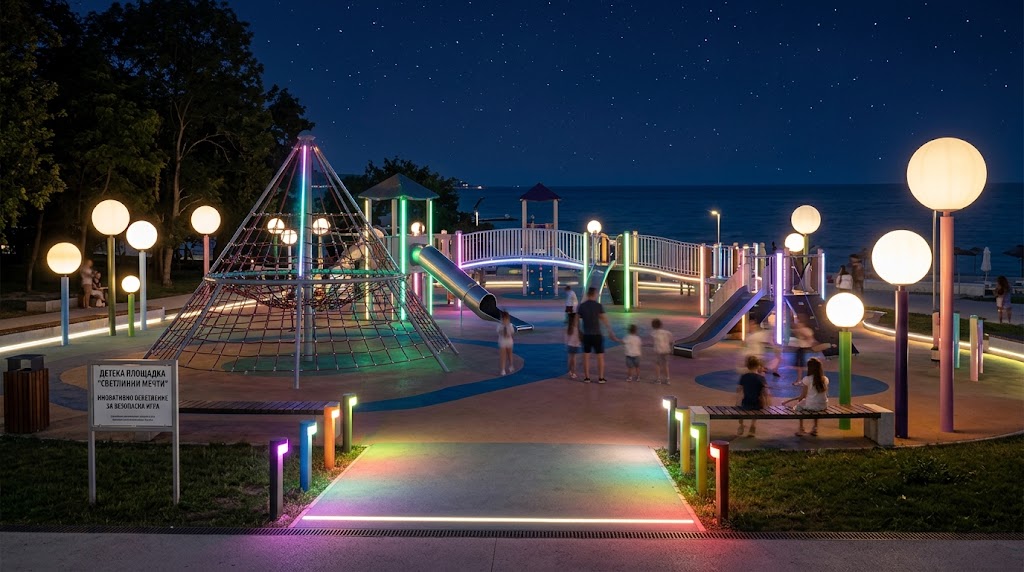
Playground lighting should allow children and adults to recognise surfaces, equipment, obstacles and people clearly without making the space excessively bright. A well-designed solution combines uniform illumination, good facial visibility, controlled glare and carefully positioned durable outdoor luminaires.
The task is not simply to illuminate the ground. Parents need to follow their children's movement, while children need to recognise kerbs, steps, changes in surface, other users and the individual parts of play equipment in time.
CIE identifies obstacle detection and facial recognition as important visual tasks in pedestrian and public-space lighting. The design should therefore consider both horizontal light on the ground and useful vertical illumination on people and equipment.
A powerful floodlight at one end of the playground and a dark area at the other do not provide good visibility. Large brightness differences make visual adaptation more difficult and can hide obstacles immediately beside brightly illuminated areas.
Photometric calculations should assess the distribution of light across the complete usable space. Entrances, slides, climbing equipment, steps, transitions between play zones and approach routes deserve particular attention.
Good illumination on the ground does not automatically mean that faces are easy to recognise. If most of the light comes from directly above or behind a person, strong facial shadows may occur.
Luminaire position and optical distribution should therefore provide useful vertical illumination as well. This helps parents and accompanying adults recognise people around them and observe activity across the playground more clearly.
Playground luminaires can enter the field of view of people who are sitting, bending down or looking upwards toward a child on play equipment. A directly visible high-brightness LED source can therefore be particularly uncomfortable.
Lighting columns should not become additional obstacles within active play zones. Their locations need to be coordinated with play equipment, entrances, benches and primary circulation routes.
Where possible, luminaires should be positioned outside the most active play areas while using suitable optics to provide the required coverage. This also reduces the risk of mechanical impact and makes maintenance easier.
Playground lighting is exposed to rain, dust, temperature changes and possible mechanical impact. IP and IK protection, housing material, corrosion resistance and mounting method should therefore be considered during product selection.
The required protection depends on the actual installation position. Polaris Lighting's park lighting range includes IP65 and IP66 luminaires with LDT/IES photometric files that can be used to evaluate light distribution before installation.
Playgrounds are often located close to homes, green areas and trees. Light should not unnecessarily enter windows, travel upward into the sky or spread deeply into surrounding vegetation.
Controlled optics help keep the useful light within the playground. This improves visual comfort for neighbouring properties while reducing unnecessary impact on the night-time environment.
A playground that is rarely or never used after a certain hour does not necessarily need to remain at full output throughout the night. Where appropriate, lighting can follow a time-based or astronomical schedule.
The system can operate at its design level during active evening hours and later be dimmed or partially switched off. Sensor-based control is also possible, but transitions should be gradual and should not leave users suddenly surrounded by darkness.
The process starts with the playground dimensions, the position and height of play equipment, entrances, benches, trees and pedestrian routes. Luminaire locations, optical distributions and the appropriate control strategy are then defined.
Photometric calculations are used to assess illuminance, uniformity, vertical light and potential glare. This allows the installation to respond to the actual geometry and use of the playground rather than simply to its total area.
Polaris Lighting provides lighting design, luminaire selection and supply of park and controlled lighting solutions for playgrounds and public spaces. Contact us if you need playground lighting with good visibility, controlled glare and a solution designed around the surrounding environment and operating schedule.
