Lighting solutions
en


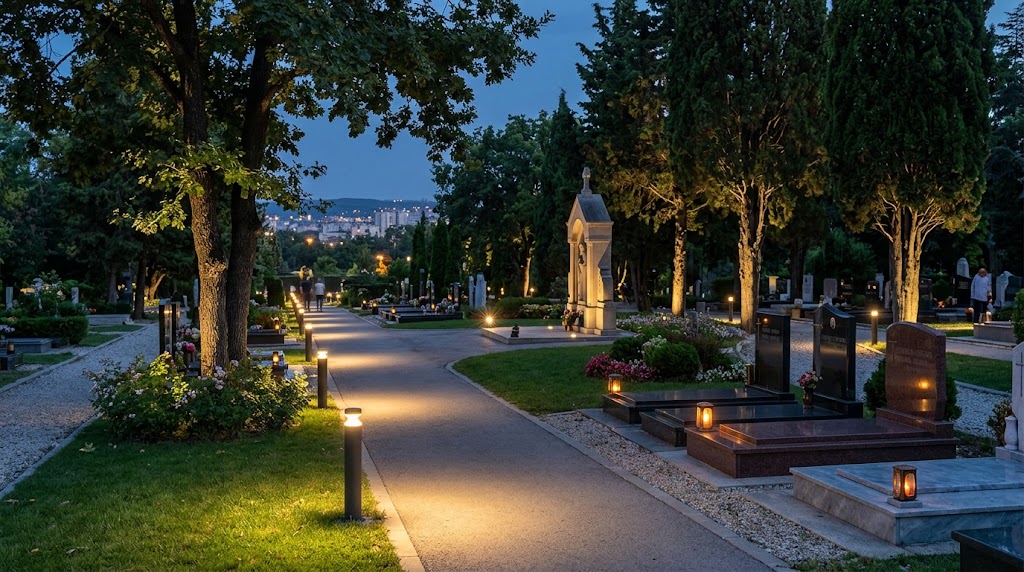
Cemetery park lighting should provide clear orientation and visibility along the main routes without making the site appear excessively bright or visually intrusive. An appropriate design uses controlled light for paths and entrances, restrained architectural lighting around administrative and ceremonial buildings, and controls that adapt operation to actual visiting hours.
A cemetery has a different visual character from a town square, retail area or active recreational park. Lighting should help visitors recognise surfaces, steps, path intersections and entrances while maintaining a calm night-time environment.
The design should therefore not begin by maximising light output. It starts by identifying the routes that are actually used after daylight fades, the critical points along them and the areas that can remain more subdued.
For pedestrian routes, uniformity is often more useful than isolated high-brightness areas. Repeated transitions between bright and dark sections force the eyes to adapt and can make surface irregularities, kerbs and steps more difficult to detect.
Luminaire position, mounting height and light distribution should therefore be determined through photometric calculations. Depending on path width, planting and required spacing, either low-level or standard park luminaires may be appropriate.
The main gate, information signs and principal route should form a clearly recognisable entrance zone. This does not necessarily require significantly higher illuminance. Better vertical illumination and controlled contrast with the surrounding area can often provide sufficient visual emphasis.
Entrances from public roads or parking areas require particular attention. Luminaires should not create direct glare for approaching drivers or pedestrians.
Administrative spaces, ceremonial halls, covered areas and building entrances require a different approach from pathways. Steps, ramps, doors and information points need good visibility.
Architectural lighting should remain restrained. An entrance, façade detail, column or other characteristic feature can be highlighted without uniformly flooding the entire building with high levels of light.
In a relatively dark environment, a directly visible high-brightness LED source can be particularly uncomfortable. It can also reduce the ability to recognise less brightly lit objects around it.
Decorative effects should not dominate this type of environment. Discreet park luminaires, restrained brightness and a consistent colour temperature are generally more appropriate along the principal routes.
Lighting can support orientation through a controlled visual hierarchy. Main paths remain easy to follow, secondary routes are more subdued, and entrances and buildings receive separate but restrained emphasis.
CIE guidance recommends controlling unwanted outdoor light at the design stage. In a cemetery park, this means limiting light outside the areas that genuinely require illumination.
Controlled optics can reduce upward light, unnecessary illumination of vegetation and spill toward neighbouring properties. This helps preserve the natural night-time environment while also reducing energy consumption.
Solar luminaires can be useful for paths and peripheral areas where installing new electrical infrastructure would be difficult or disproportionately expensive. Polaris Lighting offers solar street and park solutions suitable for pathways and outdoor spaces.
A solar system must still be sized for the specific location. Tree shading, panel orientation, required operating hours, battery capacity and seasonal conditions all need to be evaluated. The presence of a photovoltaic panel alone does not guarantee adequate year-round autonomy.
A cemetery park is rarely used at the same intensity throughout the entire night. Where the operating regime and safety requirements allow, lighting can therefore follow a time-based or astronomical schedule.
Main routes can operate at their design level during visiting hours and be dimmed later at night. Areas that need to remain accessible can be controlled independently. Complete switching-off of critical routes should be determined according to the actual operation and risk assessment of the site.
The process begins with main and secondary paths, entrances, parking, administrative and ceremonial buildings and the actual visiting schedule. We then identify which spaces need continuous illumination and where dimming, scheduled control or solar luminaires may be appropriate.
Photometric calculations are used to verify illuminance, uniformity, light distribution and potential glare. This allows the system to follow real visitor routes and visibility requirements without unnecessarily illuminating the entire site.
Polaris Lighting provides lighting design, luminaire selection and supply of park, street, solar and controlled lighting solutions for cemetery parks. Contact us if you need cemetery park lighting with uniform illumination, low glare and a calm visual character.