Lighting solutions
en

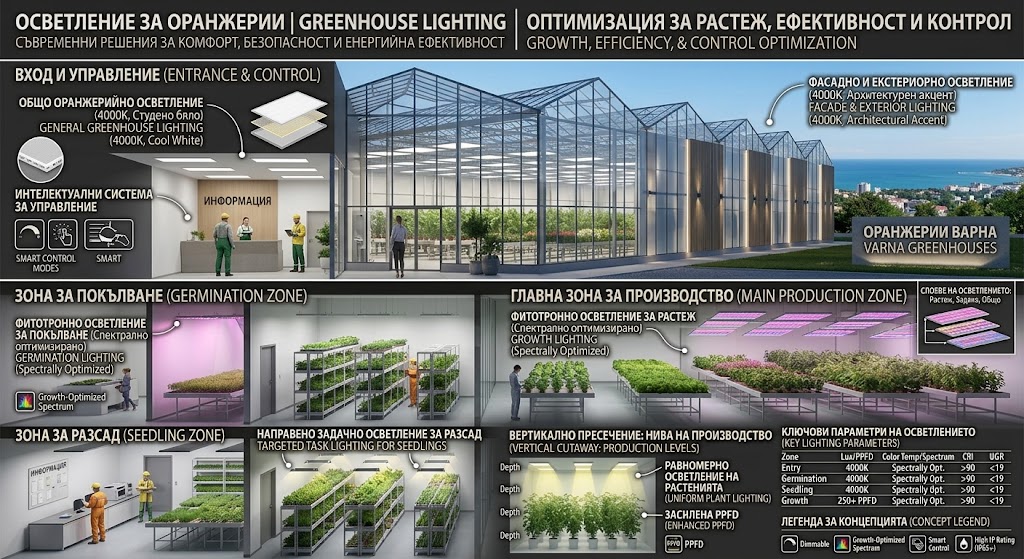
Work and service lighting for greenhouses performs a different function from specialised horticultural grow lighting. It should support safe circulation, equipment servicing, reading of labels and controls, maintenance work and activities in storage and technical rooms while remaining suitable for humidity, condensation, dust and the actual environmental conditions of the facility.
General lighting for people is designed around visual tasks such as circulation, maintenance, equipment identification and handling of materials or documents. Its specification considers illuminance in lux, uniformity, glare, colour rendering and environmental conditions.
Horticultural lighting has a different objective. It delivers electromagnetic radiation intended to influence photosynthesis, plant growth and development. Specialist plant-lighting design therefore uses photon-based quantities such as photosynthetic photon flux and photosynthetic photon flux density rather than relying only on lux.
Polaris Lighting does not currently present dedicated horticultural grow-light systems as a separate product category. This article therefore focuses on work, service, storage and technical lighting within greenhouse facilities rather than plant-growth spectra or horticultural lighting programmes.
Main and service aisles may be used by workers, carts and sometimes mechanised equipment. Lighting should reveal the floor, obstacles, thresholds, pipes and changes in level without producing excessive glare along long rows.
As a reference for indoor circulation spaces, EN 12464-1:2021 uses 100 lx for corridors. This value should not simply be transferred to every greenhouse. The appropriate level depends on the actual traffic, daylight conditions, equipment and work carried out along the route.
Uniformity is also important. Repeated bright pools beneath luminaires separated by dark areas can make movement more difficult than a moderate but consistently illuminated route.
Rooms containing irrigation controls, electrical panels, pumps, heating, climate-control equipment and other technical systems perform different visual tasks from the greenhouse growing area. EN 12464-1:2021 uses 200 lx as a baseline for plant and technical rooms.
Vertical illumination should also be considered around control panels, displays, measuring instruments and labels. Luminaire positions should avoid situations where an open cabinet door or the technician's own body blocks the light from the equipment being serviced.
A store for packaging, tools, spare parts or materials may require only basic orientation, or it may involve label reading, order preparation and picking. The required lighting level should therefore follow the actual visual task.
EN 12464-1 treats general storage and continuously occupied or more demanding working areas separately. Picking and packing activities need higher lighting levels than simple storage.
Where shelving is used, vertical illumination should also be evaluated. A good lux value on the floor does not necessarily mean that labels and stored items are easy to identify on the rack face.
A greenhouse presents a demanding environment. High relative humidity, condensation, water splash, dust, cleaning products and temperature variation can be more important to luminaire selection than nominal wattage.
The IP classification defined by IEC 60529 describes enclosure protection against the ingress of solid particles and water. The required rating should be selected for each zone and cleaning method. A humid growing area, a wash-down location and a dry technical room do not automatically require the same specification.
Housing materials, seals, operating-temperature range and resistance to substances present on site should also be checked. An IP rating alone does not establish chemical resistance.
Some service aisles and storage spaces may be occupied only intermittently. Zoned control and occupancy sensors can reduce unnecessary luminaire operating hours in these areas.
Where useful daylight is available, light-level sensing can allow artificial work lighting to remain reduced until it is needed. Greenhouse conditions can change substantially, however, as shading screens, season and time of day alter the available daylight.
If specialised horticultural lighting is installed, its controls should remain functionally distinct from the work-lighting system. The two installations serve different purposes and are evaluated using different performance criteria.
Polaris Lighting provides lighting design, photometric calculations, selection and positioning of industrial and moisture-resistant luminaires and control solutions for work and service lighting. Contact us if you need work and service lighting for a greenhouse, technical rooms or storage areas.
