Lighting solutions
en

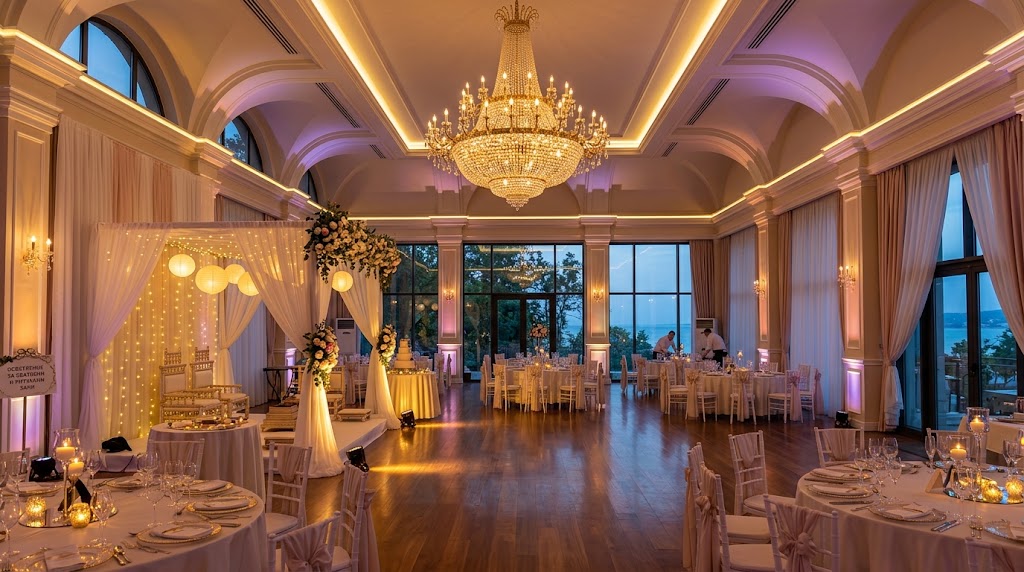
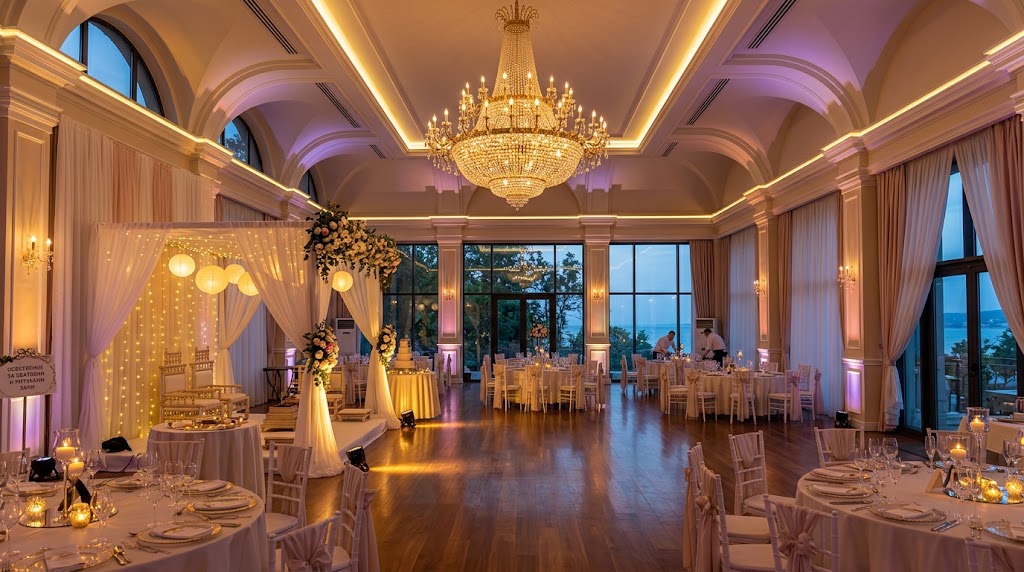
Wedding and event venue lighting has to perform several functions at the same time: create atmosphere, provide practical visibility, look good in photographs and video, and maintain safe circulation under every lighting scene. A successful design therefore relies on separate lighting layers and operating modes rather than a single general lighting system.
The reception, main hall, stage, tables, dance floor, circulation areas and façade all have different requirements. Each should be able to operate independently while remaining part of one coordinated lighting concept, without decorative lighting replacing functional or emergency illumination.
The design process begins with the way the venue will actually be used. Within a few hours, the same hall may change from preparation and guest arrival to dinner, ceremony, presentations, live entertainment and dancing. Each activity requires a different balance between general, accent and decorative lighting.
Photometric design establishes the required visibility, uniformity and glare control in functional areas. Accent and decorative layers are then added to create the desired atmosphere without compromising those basic requirements.
Guests entering the venue should immediately recognise the reception desk, cloakroom, entrance to the main hall and primary circulation routes. Lighting can be more expressive here, but staff and visitors still need to remain clearly visible.
A useful approach combines general illumination with vertical light on walls and focused accents on the reception desk, branding or decorative features. Dimming allows the entrance area to be brighter while guests are arriving and softer once the main event has begun.
A central decorative pendant or chandelier is rarely sufficient for a flexible event hall. A more adaptable solution separates general lighting, tables, architectural features, stage, dance floor and decorative accents into individual groups.
During dinner, tables can remain clearly illuminated while peripheral areas operate at a softer level. During dancing, general lighting may be reduced substantially, but routes to exits, toilets and service areas must remain easy to recognise.
Lighting above dining tables should allow guests to see faces, food and table decoration without placing high-brightness sources directly within their field of view. Suitable optics, pendant fittings, focused accents or indirect lighting can be used to create this balance.
Colour rendering also matters. Light should reproduce the colours of food, flowers, fabrics and skin naturally. This improves both the visual experience inside the venue and the quality of photographs.
Stage lighting should be considered separately from the general installation. Presenters, musicians and performers need to remain visible from the audience while also being suitably lit for photography and video.
Strong frontal illumination alone can create flat-looking subjects and undesirable shadows. A more controlled result is produced by combining different light directions and treating the stage background separately.
Where events are professionally filmed, LED equipment should also be evaluated on camera. Certain drivers or dimming conditions can cause visible flicker or banding in video even when the light appears stable to the human eye.
Photogenic lighting is not simply bright lighting. Colour rendering, light direction, shadow control and consistency of colour temperature across faces are usually more important.
Particular attention should be given to areas that frequently appear in photographs: the bridal table, stage, photo backdrop, dance floor, entrance and major decorative installations.
Key lighting scenes can also be tested with the cameras expected to be used at the venue. This helps identify excessively bright backgrounds, unwanted shadows and flicker that may not be obvious during a purely visual inspection.
Lighting controls are particularly valuable in multifunction event venues. Systems such as DALI, together with suitable phase or analogue dimming where appropriate, can control separate groups and combine them into predefined scenes.
Useful scenes can include:
The user interface should remain simple for venue staff. Frequently used scenes should be available quickly without requiring complex programming during an event.
Decorative lighting can emphasise columns, curtains, ceilings, niches, plants and other architectural features. Its purpose is to create visual depth around the guests and stage rather than compete with the primary focal points.
Façade lighting extends the experience outside the venue. Entrances, steps, approaches and characteristic architectural elements can be highlighted with carefully directed light. Exterior luminaires must have appropriate ingress protection and construction for the actual environmental conditions.
Emergency and escape lighting must remain functional regardless of the selected event scene. EN 1838:2024 specifies requirements for emergency lighting in buildings, including escape routes and open areas occupied by members of the public.
Dimming the main hall must not compromise the recognition of exits or safe circulation. Emergency lighting should be designed and powered according to the applicable requirements and coordinated with the architecture without allowing decorative control systems to disable its safety function.
A well-designed event venue can change its character substantially through lighting alone. This is achieved by combining separate functional and decorative layers, reliable dimming, appropriate colour rendering and predefined scenes rather than simply switching individual luminaires on and off.
Polaris Lighting provides lighting design and solutions for wedding and event venues, including reception areas, main halls, stages, tables, decorative and façade lighting, dimming and lighting scenes. Contact us if you need a complete lighting solution for a wedding or event venue.
