Lighting solutions
en

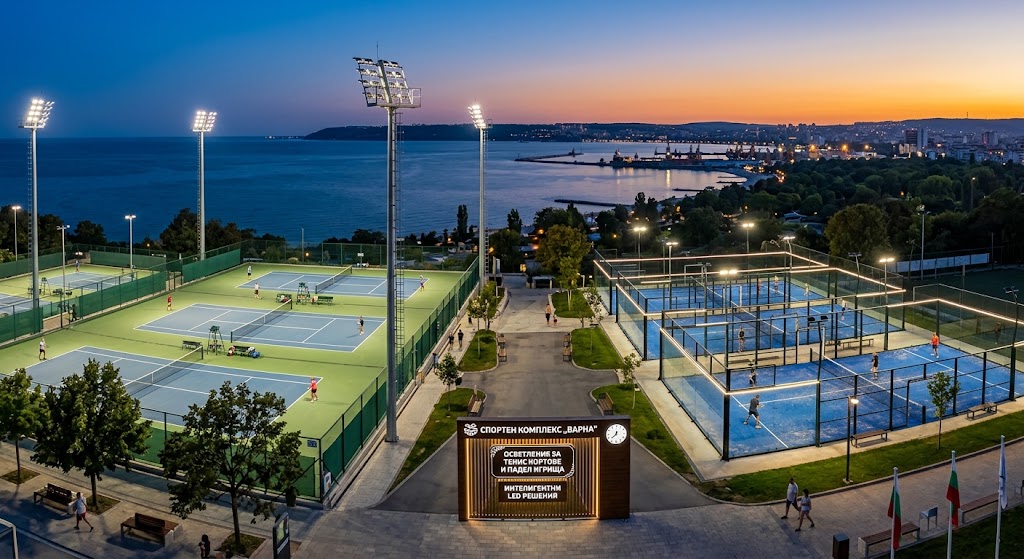
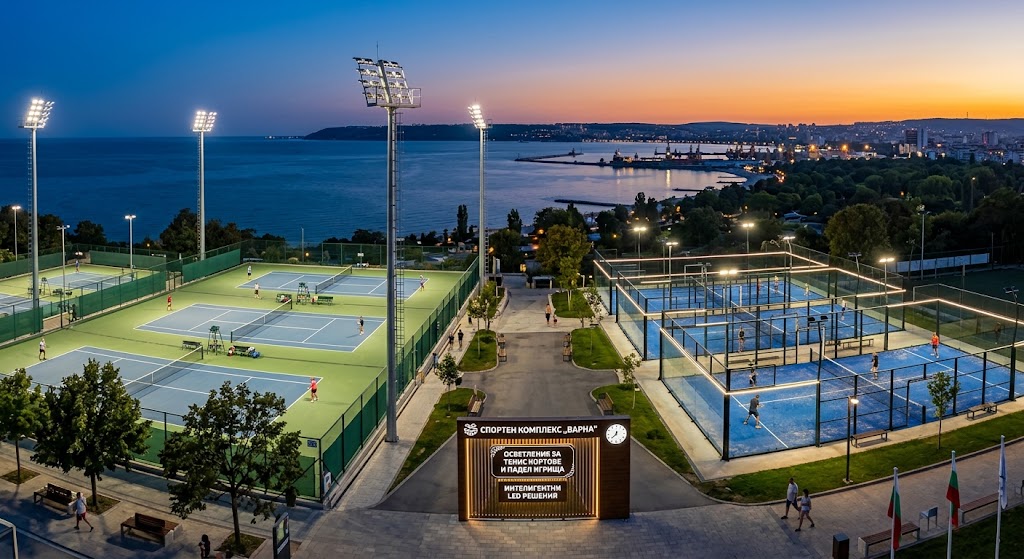
Tennis and padel court lighting must allow players to follow a fast-moving ball throughout its complete trajectory without bright floodlights entering critical viewing directions. A successful design is therefore determined not only by lux levels, but by uniformity, glare control, luminaire positioning and optical distribution.
Padel creates an additional challenge because its glass walls form part of the playing enclosure and can reflect bright light sources. Tennis and padel courts should therefore be calculated according to the geometry of the individual facility, the level of play and the way the court will be used.
EN 12193:2018 is the current European standard for sports lighting and provides criteria for illuminance, uniformity, glare restriction and colour properties in both indoor and outdoor sports facilities.
Photometric design uses the actual court dimensions, mounting positions and heights together with the photometric data of the selected floodlights. This makes it possible to identify bright and dark areas, assess uniformity and evaluate potentially problematic viewing directions before installation.
Players do not look only at the playing surface. Their eyes continuously follow the ball horizontally and vertically during serves, lobs, smashes and high defensive shots. The lighting system therefore has to provide suitable visual conditions even when a player is looking upwards.
A very bright centre combined with substantially darker baseline or corner areas can make the ball more difficult to track. Uniformity becomes particularly important as players move rapidly between the baseline, net and side areas.
A high average illuminance does not automatically mean good sports lighting. Large variations between bright and dark areas require continuous visual adaptation and can affect the perception of the ball.
Photometric calculations should cover the complete playing area rather than a few points directly beneath the luminaires. Baselines, the net area, corners and zones close to the enclosure deserve particular attention.
Glare is one of the most common problems when court lighting is selected mainly according to floodlight wattage. During normal play, athletes frequently look upwards in directions where the luminaires are installed.
Glare control starts with suitable mounting height, luminaire position, optical distribution and aiming. Excessive tilt can increase direct visibility of the light source and send unnecessary light beyond the playing area.
EN 12193 treats glare restriction as a core element of sports lighting design and also includes restrictions on luminaire positioning for relevant sports applications.
Tennis floodlights should provide balanced illumination across the length and width of the court while remaining outside critical viewing directions during serves and rallies.
The layout should not be determined by a simple rule such as a fixed number of floodlights per court. Mounting height, distance from the playing area, light output and beam distribution function as one system and should be verified through photometric modelling.
A padel court is enclosed by glass and mesh walls, with the glass forming an active part of the game. This adds another consideration to the lighting design because a bright luminaire or illuminated object may appear as a reflection in the glass and interfere with ball tracking.
The project should therefore consider not only direct sightlines towards the floodlights but also potential reflections from the rear and side glass panels. Precise optics and good control of stray light are particularly important.
The International Padel Federation requires artificial lighting to be uniform and positioned so that it does not cause visual difficulty for players, officials or spectators. Its rules also require lighting columns to be positioned outside the court and define minimum mounting conditions for the projectors.
Photometric modelling predicts light distribution, but a completed padel installation also benefits from an on-site visual assessment. Reflections depend on the glass, its condition, surrounding surfaces, viewing position and other bright objects around the court.
Testing should include realistic playing positions. The baseline, net, rear corners and upward viewing directions during a lob or smash can reveal problems that may not be obvious when an empty court is viewed from outside.
Not every use of a court necessarily requires the same operating level. Where supported by the photometric design, the installation can provide predefined modes for different activities while maintaining suitable uniformity.
Useful operating modes can include:
Dimming should not simply reduce selected groups of floodlights independently. The complete system needs coordinated control so that lower operating levels do not introduce dark patches or disturb the visual balance of the court.
Outdoor tennis and padel projects must also consider light beyond the playing area. Excessively wide or poorly aimed beams can illuminate neighbouring properties, roads and the night sky without improving conditions for players.
Suitable optical control keeps more of the useful light within the court. This improves system efficiency while reducing unnecessary environmental impact and potential disturbance outside the facility.
Effective tennis and padel lighting begins with the ball trajectory and the viewing directions of the players. Photometric calculations establish the required distribution and uniformity, while padel projects need the additional assessment of the glass enclosure and potential reflections.
Polaris Lighting provides photometric design and solutions for sports and exterior lighting. Contact us if you need lighting design and luminaire selection for a tennis or padel court based on its specific geometry and operating requirements.
