Lighting solutions
en

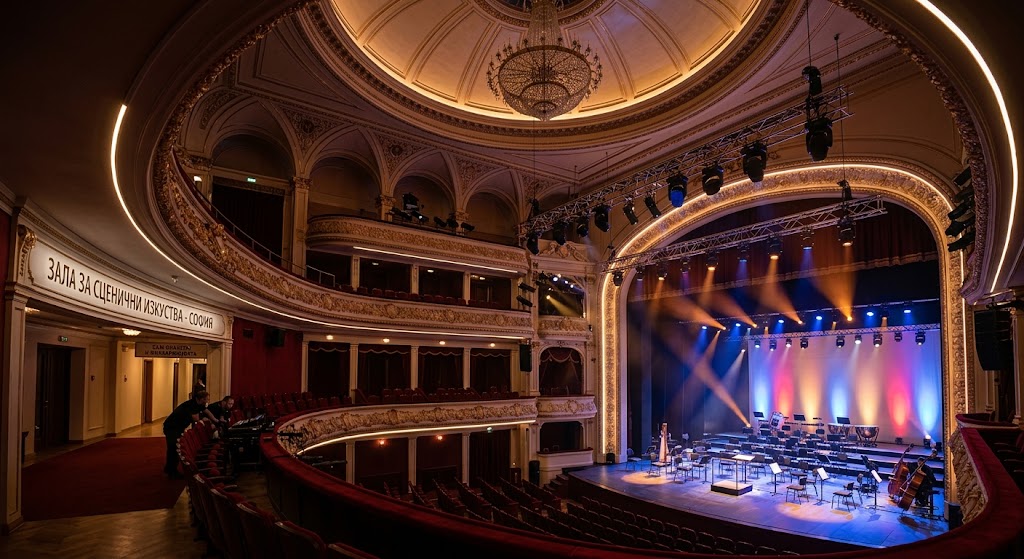
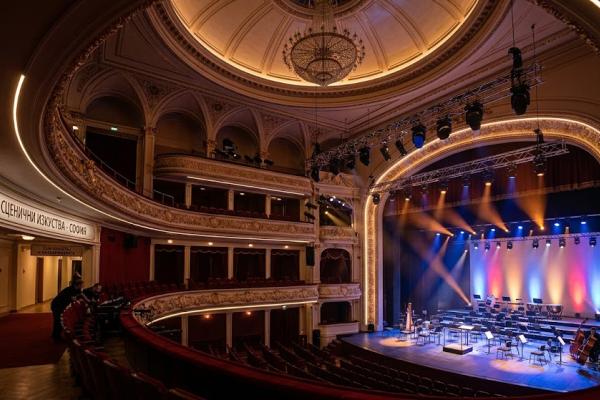
Opera and concert hall lighting has to operate simultaneously as an architectural, functional and technical system. The auditorium requires smooth dimming and multiple lighting scenes, foyers and balconies need safe visual orientation, and equipment located in acoustically sensitive spaces must operate without introducing distracting noise during performances.
Auditorium lighting cannot be designed as a standard public space with one permanent light level. Before a performance, visitors need sufficient visibility to locate rows and seats. During the event, house lighting is reduced to the level required by the production, while cleaning and technical maintenance require a substantially brighter working mode.
EN 12464-1:2021 treats theatres and concert halls as a separate application. For spectator seating areas during maintenance and cleaning, it specifies 200 lx at floor level, UGR 22 and Ra 80. Stage areas used for rigging have a baseline requirement of 300 lx.
These values do not define the artistic lighting during a performance. Performance conditions are established through dedicated scenes according to the venue and the production.
In an opera house or concert hall, even small visible steps in brightness can become noticeable when house lighting moves from full output towards darkness. Drivers and control systems should therefore be selected according to their actual low-level dimming performance rather than simply whether a luminaire is described as dimmable.
Professional auditorium projects use systems capable of deep dimming and controlled fade transitions. DALI, for example, supports individual and group addressing, configurable fade times and recall of predefined scenes.
Useful presets can include audience entry, performance start, interval, post-show, rehearsal, cleaning and maintenance modes.
Balconies, boxes and stepped circulation routes require discreet lighting that makes movement possible without drawing attention away from the stage. Low-level linear light, integrated handrail solutions or lighting within architectural details can support orientation, but glare should always be checked from normal audience viewing positions.
Balcony fronts are also frequently important architectural surfaces. Decorative lighting can reveal their form, material or texture, but it should not create bright reflections that compete with the performance.
The foyer forms the transition between the exterior environment and the auditorium and becomes especially active during intervals. EN 12464-1:2021 uses 100 lx as a baseline for entrance halls, with Ra 80 and UGR 22. The architectural concept may justify higher levels and additional accent lighting.
Foyers can combine general illumination, decorative luminaires, wall washing and focused light on art or architectural details. Independent control of these elements allows the space to move from a daytime setting to a more atmospheric evening scene.
Concert hall walls and ceilings can incorporate acoustic panels, reflectors, diffusers and other elements whose geometry and position are defined by the acoustic design. Lighting should not be added later in a way that compromises these surfaces or interferes with their acoustic purpose.
Light can be integrated into acoustic panels, linear systems or architectural recesses, but coordination between the lighting designer, architect and acoustic consultant should take place early. International opera-house projects demonstrate that even major decorative lighting elements can form part of both the architectural and acoustic concept when the two disciplines are developed together.
Chandeliers, pendants and bespoke decorative luminaires can become a defining element of an opera house or concert hall. Their specification should also consider weight, suspension, maintenance access, dimming performance, behaviour at very low output and possible effects on sightlines and acoustic surfaces.
Where the architecture is highly specific, a custom luminaire or linear system may need to be manufactured to defined dimensions and technical requirements instead of adapting a standard product.
The background noise level in a concert hall can be extremely low. A fan, motor or electronic component that would be almost unnoticed in a retail environment may become clearly audible during a quiet passage of music.
Equipment within acoustically critical areas should therefore be evaluated for noise. Where required, luminaires can use passive or convection cooling without fans. Specialist stage fixtures are available specifically for opera houses, theatres and concert halls where silent operation is treated as a measurable technical characteristic rather than a subjective preference.
EN 1838:2024 requires a minimum horizontal illuminance of 1 lx along emergency escape routes. Where open-area anti-panic lighting is required, the minimum horizontal illuminance in the core area is 0.5 lx.
This is particularly important in auditoriums containing large numbers of visitors. Artistic blackout, DALI scenes or theatrical control must never interfere with emergency operation, exit identification or the required visibility along escape routes.
Polaris Lighting provides lighting design, photometric calculations, decorative, linear and acoustically integrated lighting solutions, control systems, emergency and escape lighting and bespoke lighting configurations developed to project-specific requirements. Contact us if you need lighting for an opera house, concert hall or other performing-arts venue.
