Lighting solutions
en

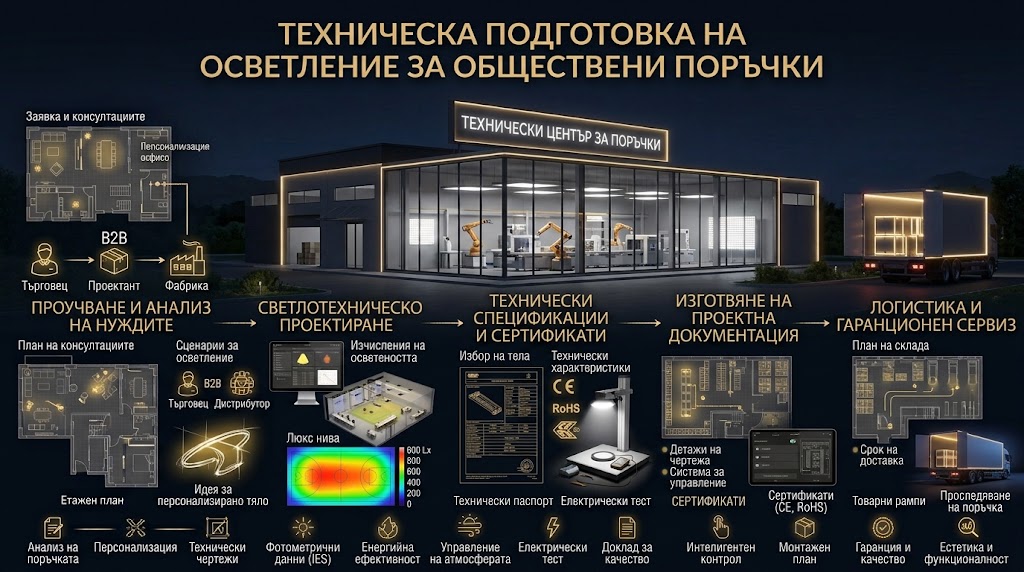
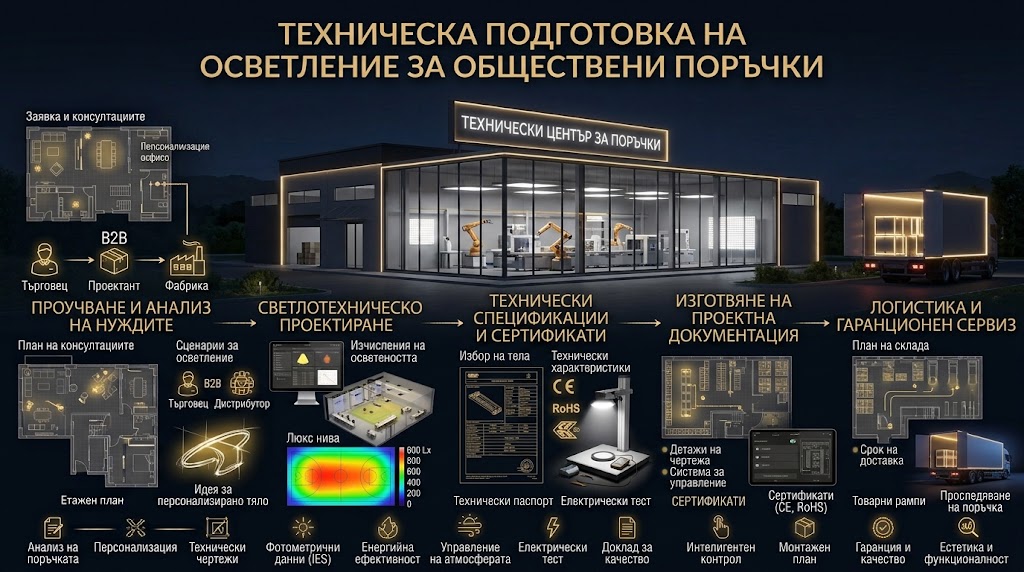
Lighting for public procurement requires careful technical preparation as well as competitive pricing and reliable delivery. Polaris Lighting can support projects with photometric calculations, product specifications, LDT and IES files, proposed technical equivalents, product documentation, samples, lead-time checks and logistics. The company does not act as an authority approving the design or deciding whether a tender complies with the procurement requirements.
The first step is to review the technical specification, bill of quantities, drawings and luminaire requirements. The aim is to identify the parameters that must actually be demonstrated for each item.
These may include luminous flux, power, efficacy, colour temperature, colour rendering, ingress protection, mechanical resistance, dimensions, mounting method, optics, control options or specific photometric results.
These characteristics need to be considered together. A luminaire with similar wattage, for example, is not automatically technically equivalent if its light distribution is different and it cannot achieve the required results within the actual project.
Where procurement documents specify requirements for illuminance, uniformity, glare or other lighting criteria, these can be checked through photometric calculations using the actual proposed luminaires.
Professional software combines the geometry of the project, mounting positions and the photometric data of the product. The expected performance can therefore be evaluated before the luminaires are ordered and installed.
Polaris Lighting provides photometric calculations and can supply the technical information required by designers, bidders and contractors. A lighting calculation provides technical evidence. It does not constitute formal approval of a design or tender.
LDT and IES files describe the light distribution of a specific luminaire. They allow the product to be imported into professional lighting design software and independently analysed within the project geometry.
This is particularly useful in public procurement because lighting performance can be checked using product-specific photometric data rather than only catalogue images or general descriptions. Polaris Lighting provides LDT and IES files for its principal models where such documentation is available for the relevant product.
Where procurement documents allow an “or equivalent” solution, a proposed product should not be considered equivalent merely because it looks similar to the referenced model. The characteristics relevant to the subject of the procurement need to be compared.
A practical comparison may include:
Polaris Lighting can propose an alternative luminaire and provide technical data for comparison. The final decision on whether a proposed equivalent complies with the requirements of the specific procurement procedure remains with the relevant parties to that procedure.
A useful lighting specification describes measurable characteristics. General phrases such as “high-efficiency LED luminaire” provide less technical certainty than clearly defined performance, optical and installation requirements.
Polaris Lighting can provide datasheets, dimensions, electrical characteristics, optic information, mounting details, control options and available project documentation. This information can support designers or tenderers preparing their technical submission.
Depending on the product, applicable documentation may include EU declarations of conformity, technical datasheets, test reports, certificates or other evidence. European legislation, for example, provides for EU declarations of conformity for electrical equipment and equipment falling within applicable electromagnetic compatibility legislation.
The same document package should not automatically be assumed for every type of luminaire. The requirements of the specific procurement documents and the legislation applicable to the individual product need to be checked.
Some procedures or project decisions may benefit from physical product verification. A sample allows dimensions, housing, diffuser, optic, finish and mounting details to be assessed in ways that may not be obvious from a datasheet.
Where possible and subject to availability, Polaris Lighting can support technical product presentation or sampling. Where a sample is formally required by the procurement procedure, its format, submission method and deadline must follow the contracting authority's documentation.
Delivery time can form part of the contractual obligations in a public procurement project. The fact that a luminaire exists in a catalogue does not confirm that the required quantity is available within the project programme.
Current stock, quantities and expected manufacturing or supply lead times can therefore be checked before a quotation is finalised. If a specific model cannot meet the required programme, a technically suitable alternative may be considered where the procurement conditions permit it.
A procurement contract may cover one major site, several buildings or phased deliveries. Logistics should therefore reflect the installation programme, delivery points and available storage capacity.
Polaris Lighting organises delivery to offices, warehouses or directly to project sites and offers delivery with its own transport for B2B customers. Quantities can be structured by product position, site or project stage so that deliveries follow the actual implementation sequence.
Polaris Lighting can act as a technical lighting partner by preparing calculations, supplying product information, proposing alternatives, comparing technical parameters and organising supply.
The company does not define the procurement requirements, approve the investment design, determine whether a proposed equivalent is admissible or replace the contracting authority, designer, supervision team or tender evaluation committee.
Polaris Lighting provides photometric calculations, product specifications, LDT/IES files, technical alternatives, product documentation, stock and lead-time checks and logistics support for the lighting scope of public procurement projects. Contact us if you need technical support and lighting supply for a specific public procurement project.
