Lighting solutions
en

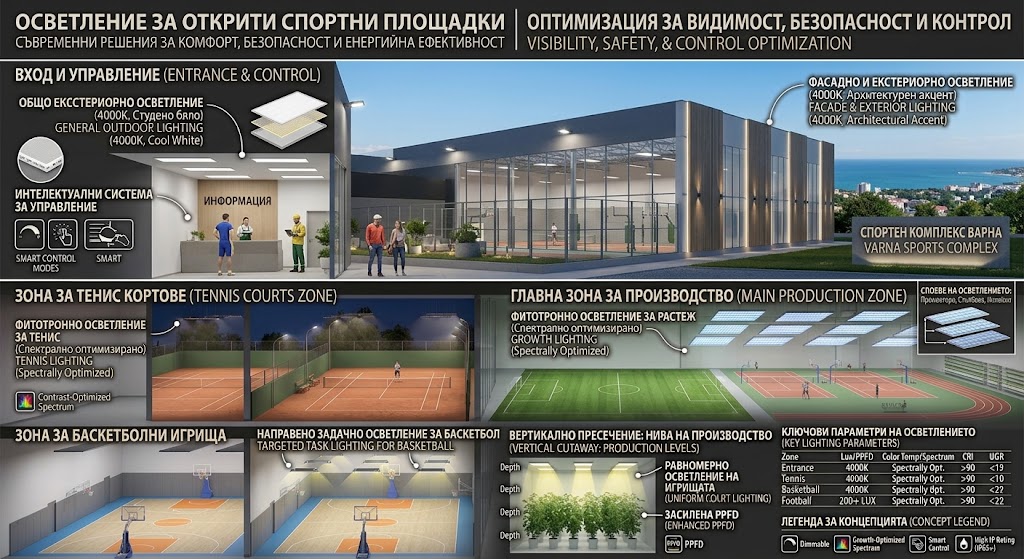
Lighting for municipal outdoor sports courts should provide sufficient and uniform visibility across the playing surface without excessive glare for players, spectators or neighbouring properties. Selecting powerful floodlights alone is not enough. Pole height and position, optics, the sport being played, operating mode and lighting controls should all be verified through photometric calculations.
EN 12193:2018 addresses lighting for different sports and divides applications into three lighting classes. Class III generally covers training, school and recreational sport and lower-level competitions. Classes II and I apply to increasingly demanding competition and training levels.
This distinction is important for municipal facilities. A neighbourhood court intended for recreational use does not automatically have the same requirements as a venue hosting organised competition. Football, basketball, tennis and multipurpose courts also have different reference areas and lighting requirements.
Compliance with a particular competition class should therefore only be stated after calculations have been completed for the actual facility and intended sport.
An average lux value does not show whether the playing area is well illuminated. If there are bright pools directly below the floodlights and dark areas between them, players have to adapt continuously to changing brightness levels.
EN 12193 therefore specifies both illuminance and uniformity requirements across defined reference areas. In football, for example, both the required light level and uniformity increase as the lighting class becomes more demanding.
Where one municipal court is used for several sports, the lighting model should consider the most demanding relevant visual task among the sports that will actually be played.
In basketball, football, volleyball, tennis and similar sports, players frequently look upwards to follow a fast-moving ball. A floodlight that appears acceptable from outside the playing area may still cause significant glare from a player's normal viewing direction.
EN 12193 uses the GR glare rating for sports-lighting applications. Suitable optics, shielding, aiming angles and pole positions should control glare at the design stage rather than relying on reducing output after installation.
Spill light beyond the playing area should also be considered, particularly where the facility is close to residential buildings, roads or public parks.
There is no single pole height that is suitable for every municipal sports court. The correct height depends on court dimensions, the number and location of poles, luminaire optics, the sport, required illuminance and the limits placed on glare and spill light.
Higher mounting positions can provide more favourable aiming angles and smoother light distribution, but they also require suitable structures, engineering calculations and practical access for maintenance. Low poles fitted with high-output floodlights can increase glare and create stronger variations between bright and dark areas.
Pole height, position and luminaire aiming should therefore be developed together in the photometric model. The pole structure must also be engineered for the relevant mechanical and wind loads.
Sports floodlights operate in rain, dust, temperature variations and UV exposure and may also face mechanical risks. Wattage and lumen output are therefore only part of the specification.
A single IP or IK rating should not automatically be specified for every sports facility. Protection requirements should follow the actual environment and installation conditions.
Municipal sports courts normally operate within defined opening hours. Lighting can be switched automatically according to time or astronomical schedules, with manual override available for authorised staff or organised events.
Where suitable control gear is used, floodlights can also be grouped and dimmed. DALI supports group control and predefined lighting scenes, while scheduling can be implemented through the relevant application controller or building-management platform.
Every use of the facility does not necessarily require maximum design output. Different operating modes can be established according to actual activity:
If a municipal facility is intended to host official or professional competitions, the required lighting class cannot be established from the number or wattage of floodlights alone. The sport, competition level, reference area, illuminance, uniformity, glare and any additional requirements must first be verified.
The model includes court dimensions, pole positions, mounting heights, luminaire aiming and the photometric data of the selected floodlights. Illuminance, uniformity, glare and light distribution beyond the main playing area can then be evaluated before installation.
Polaris Lighting provides lighting design, photometric calculations, luminaire selection and positioning and control solutions for exterior lighting projects. Contact us if you need a lighting project for a municipal outdoor sports court.
```