Lighting solutions
en

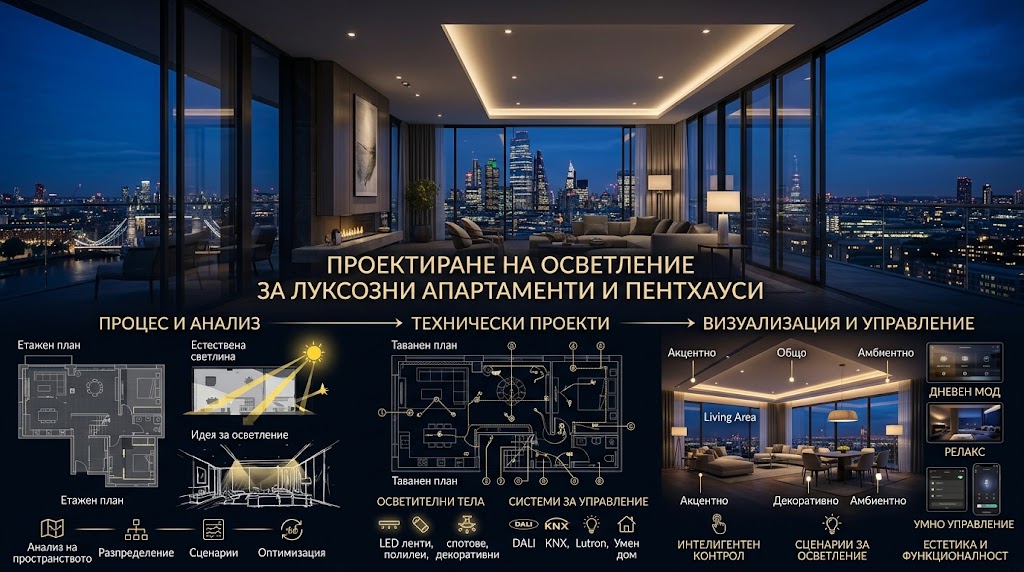
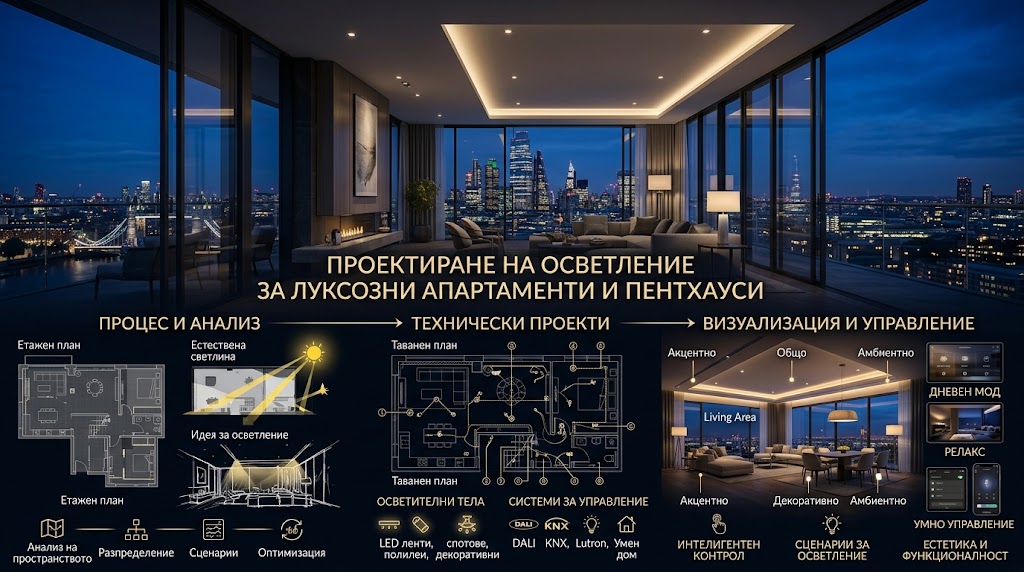
Lighting for high-end residences should be designed as part of the architecture, not added as a final decorative layer. The best results come when concealed lines, magnetic systems, custom dimensions, driver locations, control scenes and furniture relationships are resolved before ceilings are closed.
In a house or apartment with a bespoke interior, the key question is not how many luminaires are needed, but how light will work with the architecture. A room may need ambient, accent, decorative and task lighting without making the ceiling look crowded.
The process should start with floor plans, ceiling plans and furniture layouts. We review axes, ceiling heights, niches, curtain pockets, kitchens, wardrobes, artwork, finishes and surfaces that need emphasis. When lighting is considered only after the ceilings are complete, the choice is often limited to what can still be installed.
Custom dimensions are especially valuable in linear lighting. A profile intended to follow a kitchen island, dining table, corridor or furniture composition rarely matches a standard length perfectly. A project-specific solution allows the length, form, suspension method, finish and power-feed position to be defined in advance.
Concealed lighting can separate a ceiling from a wall, reveal texture or provide soft evening light. The critical detail is to keep the LED source out of direct view and provide enough depth for a continuous light line. This is why the profile, plasterboard detail and furniture construction need to be coordinated together.
Magnetic track systems suit interiors that need a clean architectural line and the flexibility to change lighting modules later. Trimless versions can be integrated into ceilings or walls, while different modules can combine linear, directional and decorative light within one system.
Selection should not be based on appearance alone. The specification needs to check operating voltage, profile size, available modules, optics, colour temperature, colour rendering, dimming and access to power components. Polaris Lighting offers 23 mm magnetic systems for recessed, surface and suspended installation, with DALI dimming available in selected configurations.
A high-end interior does not require every luminaire to come from the same brand. A decorative pendant may be the visual focal point, while general and accent lighting remains almost invisible. What matters is compatible colour temperature, good colour rendering and consistent dimming behaviour.
Polaris Lighting combines its own systems with international brands including Delta Light, REDO Group, Nowodvorski Lighting, Maytoni, Nova Luce and LEDS C4. The project can therefore be built around function, architectural detail and visual intent rather than one product family.
A living room rarely needs only one mode. A well-planned control strategy can include scenes such as everyday, dining, guests, TV and night. A lighting scene is a predefined combination of luminaire groups and dimming levels recalled from a button, control panel or automation system.
If DALI or another addressable control system is planned, that decision should be made before cabling. DALI supports individual and group control as well as preset scenes. The practical question is not how much automation can be added, but which functions the occupants will actually use.
A catalogue cannot fully show how a finish, optic or light effect will behave in the real interior. Key luminaires, colours and light effects should be viewed in person or tested where possible. Decorative finishes, beam angles, reflections on stone, timber and lacquered surfaces, and behaviour at low dimming levels deserve particular attention.
Lighting interfaces with the architect, interior designer, electrical designer, ceiling contractor, furniture maker and control-system integrator. Before manufacturing and delivery, final ceiling plans, cut-outs, heights, cable routes, power supplies, access points and positions relative to furniture should be confirmed.
Typical problems include selecting luminaires after the ceiling is finished, leaving no service access to drivers, mixing colour temperatures without a reason, using too many visible light sources and specifying controls that are more complicated than daily use requires. Another risk is ordering a decorative fixture before the final table, island or suspension height is known.
Polaris Lighting provides lighting design, custom-made luminaires, magnetic and linear systems, designer lighting selection, control planning and coordination for complete residential projects. Contact us if you need lighting for a high-end residence coordinated with the architecture, interior design, furniture and ceilings.
