Lighting solutions
en

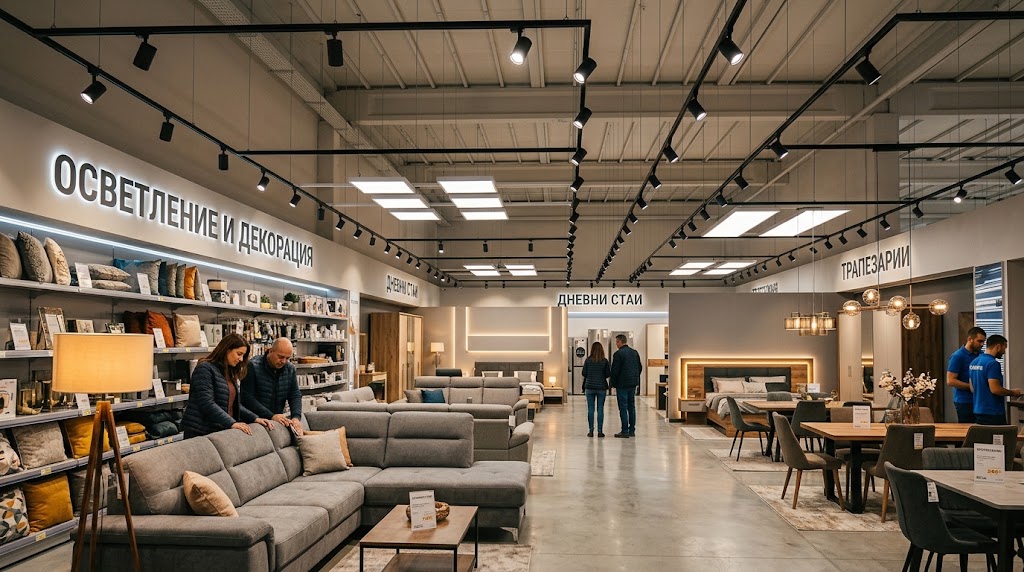
 Lighting for furniture and interior showrooms should reveal not only the products themselves but also how they could look in a real interior. A sofa, timber finish, textile or kitchen front can appear noticeably different under unsuitable light, so the design should combine realistic colour rendering, ambient and accent lighting and a system that can adapt when displays change.
A furniture showroom is often a collection of small interiors within one large commercial space. Living rooms, kitchens, bedrooms, dining areas, wardrobes and material displays perform different functions and should not automatically receive identical lighting.
A sample living room may combine soft ambient light with accents on a sofa, coffee table or feature wall. In a kitchen display, the worktop, cabinet fronts and finishes should remain clearly visible. A bedroom setting may use lower levels and softer distribution to create a more realistic residential atmosphere.
Material libraries containing timber, fabrics, stone, tiles and colour samples have another priority. Customers need to see colours and textures as accurately and consistently as possible without a strong colour shift introduced by the lighting itself.
The colour rendering index Ra describes how naturally colours are reproduced under a light source compared with a reference source. EN 12464-1:2021 uses Ra 80 as a baseline for general retail areas, but furniture and interior showrooms can justify higher colour-rendering performance where material selection is an important part of the purchasing decision.
When customers compare similar shades of timber, upholstery, paint or stone, luminaires with Ra 90 or higher can be an appropriate design choice. Ra alone, however, should not be treated as the complete specification. Colour temperature and consistency between neighbouring luminaires also influence how materials are perceived.
A sample should ideally not be illuminated simultaneously by sources with visibly different colour temperatures. This can make one continuous surface appear to change colour from one side to the other.
Track systems are particularly useful in showrooms where furniture collections and display compositions are regularly updated. Spotlights can be moved along the track and aimed again when a sofa is replaced by a table, a new collection arrives or an entire room set is reorganised.
This flexibility has a practical advantage. With fixed lighting points, a major layout change can leave the light focused on the previous product position. Track lighting allows the accent to follow the new merchandising layout.
Medium or wider beam distributions are usually suitable for larger furniture pieces. Narrow beams are useful for smaller objects, samples and decorative details, but can create an unnecessarily concentrated bright patch when aimed at a large sofa or dining table.
Magnetic systems offer another way to create visually clean and adaptable showroom lighting. Depending on the specific system, a single magnetic track can accommodate linear modules, adjustable spotlights and other compatible luminaires.
This makes it possible to combine general illumination from a linear module with directional accent light on furniture or a decorative composition. When the display changes, the lighting configuration can be adjusted without creating a new fixed lighting point for every product position.
A lighting scene is a predefined combination of lighting groups and dimming levels. A model living room, for example, could have a general viewing scene, a softer evening scene and another setting that emphasises a particular piece of furniture or material.
Where the control system allows independent addressing, ambient, linear, decorative and accent lighting can be organised into separate groups. With a suitable system such as DALI, groups and control behaviour can be reconfigured through software without necessarily changing the physical wiring.
If Tunable White luminaires are used, a scene can also change the colour temperature. This can demonstrate how an interior looks under warmer or more neutral light. For accurate comparison of materials, however, it is useful to retain a dedicated scene with consistent lighting conditions so that colour judgement is not influenced by changing settings.
A common mistake is to illuminate the entire showroom at a high and uniform level. This removes visual hierarchy and can make carefully designed room sets resemble warehouse displays.
A more effective approach uses ambient lighting to provide orientation and visual comfort while track or magnetic spotlights direct attention towards furniture, textures and key compositions. Linear lighting can support circulation routes, vertical surfaces, niches, shelving and architectural lines.
A good furniture showroom lighting system should not be designed only around today's floor plan. The lighting project should identify areas that are likely to change, locations requiring movable accents and lighting groups that need independent control.
Polaris Lighting provides lighting design, photometric calculations, selection and positioning of track, magnetic and linear systems and lighting control solutions. Contact us if you need lighting for a furniture or interior showroom.
