Lighting solutions
en

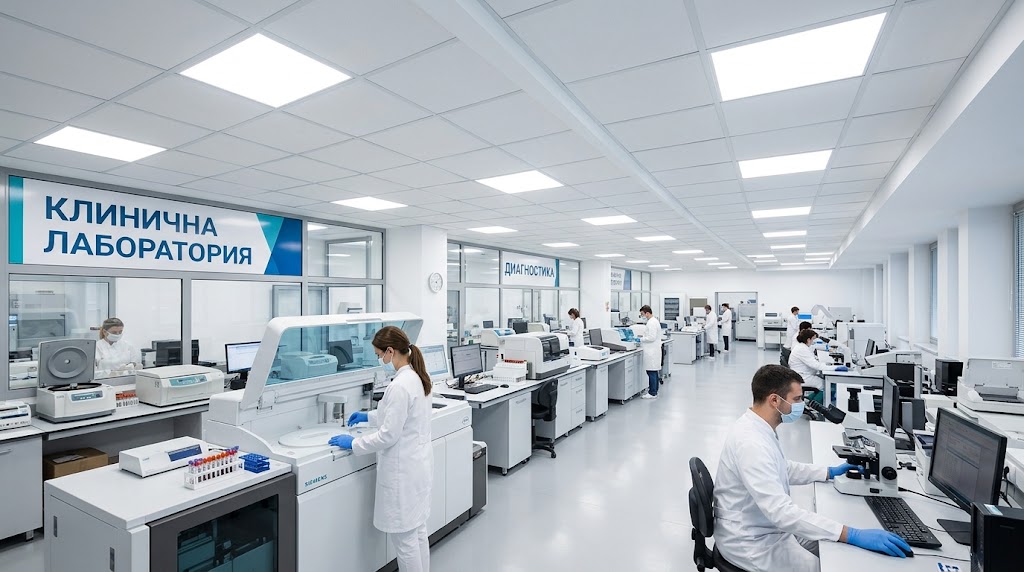
Diagnostic laboratory lighting should support accurate and comfortable visual work at benches, sample preparation points and analyser stations without creating strong glare, shadows or unwanted temporal light modulation. A single lighting scheme for the entire room is rarely sufficient. The design should follow the actual laboratory workflow, equipment and visual tasks within each zone.
Before luminaires and output levels are selected, the actual process needs to be understood. Relevant information includes the sample route, receiving and preparation areas, workbenches, analysers, microscopy or other specialised positions, computer workstations, storage areas and waste-handling points.
The World Health Organization recommends assessing the specific lighting requirements of individual laboratory procedures. Different areas may require higher or lower light levels, while undesirable shadows, reflections and glare should be avoided.
For laboratories, EN 12464-1:2021 provides a baseline of 500 lx maintained illuminance, UGR 19 for glare limitation, uniformity U0 of 0.60 and Ra 80. These values are a starting point for general laboratory work rather than a universal specification for every procedure.
At the workbench, the distribution of light is as important as the average illuminance. A bright central area surrounded by significantly darker surfaces forces repeated visual adaptation. Luminaire positioning should also reduce shadows created by the worker's hands and body.
Where a particular procedure requires a higher level, local task lighting can supplement the general system. It should be integrated without creating excessive contrast with the surrounding area.
Staff working around automated analysers may need to view displays, load samples, read labels and barcodes and identify status indicators at the same station. A high-luminance ceiling fixture or poorly chosen light direction can create reflections on displays and glossy equipment surfaces.
The layout should also respect the requirements of the specific analyser. Where the equipment manufacturer specifies restrictions concerning ambient light, service clearances or positioning in relation to windows and luminaires, these should become part of the lighting brief. Different analysers should not be assumed to have identical requirements.
The Ra colour rendering index describes how naturally colours are reproduced by a light source. EN 12464-1 uses Ra 80 as the baseline for general laboratory activities. Where visual colour assessment forms part of a procedure, higher requirements should be considered.
For colour inspection, lighting practice can require 1000 lx and Ra 90. This does not mean that every diagnostic laboratory should use these values throughout. Higher colour-rendering performance should be specified where the actual method depends on reliable visual differentiation between colours or subtle shades.
LED lighting can produce rapid variations in light output that are not always perceived as obvious visible flicker. Luminaire selection should therefore consider the performance of the light source and driver rather than focusing only on wattage and lumen output.
EU Regulation 2019/2020 sets PstLM ≤ 1.0 at full load for applicable mains-operated LED and OLED light sources and, since 1 September 2024, SVM ≤ 0.4 for stroboscopic effects, subject to the exemptions defined in the Regulation. For dimmable installations, performance should also be checked at the control levels that will actually be used.
In a laboratory environment, the construction of a luminaire should correspond to the cleaning and disinfection regime of the specific room. Smooth, enclosed surfaces, fewer locations where dust can accumulate and suitable materials can simplify routine maintenance.
An IP rating describes protection against ingress of solid particles and water, but it does not automatically demonstrate that a luminaire is suitable for every laboratory cleaning procedure. Housing design, materials and compatibility with the cleaning agents used on site should also be checked.
EN 1838:2024 specifies a minimum horizontal illuminance of 1 lx on escape routes and 0.5 lx in the core area of spaces requiring open-area anti-panic lighting. High-risk task areas are treated according to risk and must provide sufficient emergency lighting for the activity to be made safe.
This can be particularly relevant in a laboratory where a sample, chemical or active procedure has to be secured after a loss of normal power. Emergency lighting is not, however, a substitute for a UPS or standby power supply where specific laboratory equipment must remain operational.
For a diagnostic laboratory, the lighting design should be coordinated with laboratory specialists, building designers and equipment suppliers before final luminaire positions are fixed. This allows the lighting to follow the real workstations and technical restrictions rather than forcing the laboratory workflow to adapt to an installation that has already been completed.
Polaris Lighting provides lighting design, photometric calculations, luminaire selection and positioning, and emergency and exit lighting solutions according to the requirements of the individual facility. Contact us if you need a lighting project for a diagnostic laboratory.
```