Lighting solutions
en

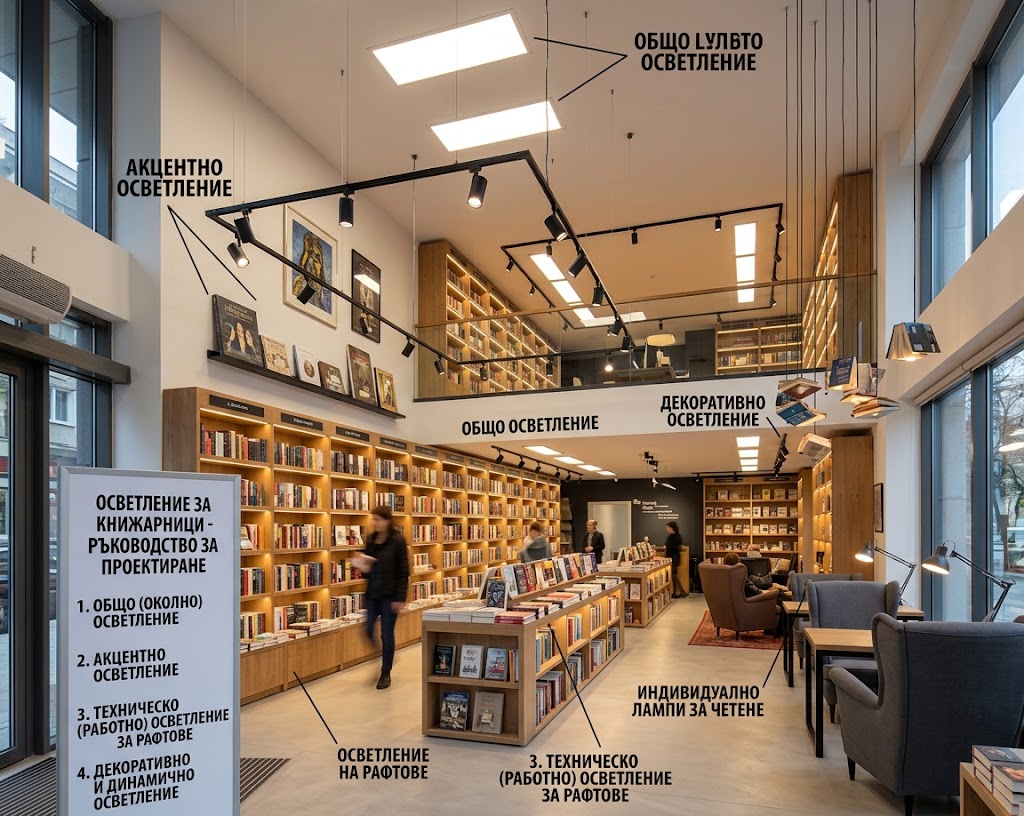
Bookstore lighting should make titles on shelves easy to read, books on display tables comfortable to browse and the main functional areas immediately recognisable. This requires more than uniform general illumination. Shelves, display tables, checkouts, children's areas, shop windows and event spaces all perform different visual tasks.
Books are primarily displayed on vertical surfaces. Lighting only the floor and aisles may therefore provide sufficient illuminance within the room while leaving book covers and titles on the shelves comparatively dark. Both horizontal and vertical surfaces need to be considered in the lighting design.
Light should reach the shelf fronts consistently from the top to the lowest rows. If upper shelves are very bright while books closer to floor level remain in shadow, customers have more difficulty scanning titles and categories.
Asymmetric distributions, wallwashers or correctly positioned track spotlights can be used for this task. Specialist library guidance also identifies vertical illumination as an important factor in making titles on book spines easy to recognise.
With high shelving, luminaire positions should follow the front plane of the bookcase rather than simply the geometric centre of the aisle. This directs useful light towards the merchandise instead of concentrating it primarily on the floor.
Tables containing new releases, bestsellers or themed selections are horizontal merchandising areas and can receive a stronger lighting accent. Directional spotlights help distinguish these displays from the surrounding circulation space.
Customers should be able to examine covers, illustrations and text without a bright source entering their direct field of view. Where tables are regularly repositioned, fixed spotlights quickly lose their relationship with the merchandise. Track lighting allows fixtures to be moved and redirected as the layout changes.
A bookstore does not need to be equally bright everywhere. General lighting provides orientation, while higher light levels can be concentrated on books, browsing tables and other areas where customers actually read.
However, excessively large brightness differences between neighbouring zones should be avoided. Repeatedly moving between strongly illuminated displays and dark aisles increases the demand on visual adaptation and can reduce comfort.
The checkout is both a workplace and a wayfinding point. Employees need clear visibility of books, labels, payment methods and the working surface, while customers should be able to locate the counter quickly.
Luminaires should be positioned to minimise reflections on monitors and payment terminals. A pendant or dedicated decorative accent may identify the checkout visually, but sufficient and uniform functional lighting should remain available for staff.
A children's area can have a warmer and more distinctive visual character while still providing suitable illumination for books, tables and reading activities. Decorative fixtures mounted at lower levels should remain outside active play and circulation zones.
Concealed linear lighting, compact pendants or accents on walls and shelving can distinguish the area from the rest of the bookstore without relying on excessive brightness or strong colour effects.
Window displays change with campaigns, book launches, seasons and new releases. Accent lighting should therefore adapt to different arrangements of books, posters and decorative elements.
Track spotlights with different or adjustable beam distributions can provide a narrow highlight on a single title or broader illumination across an entire display. With glazed shop windows, reflections should also be assessed from the customer's normal viewing position.
Many bookstores use part of the sales floor for author talks, book launches, children's readings and discussions. These activities require a more flexible lighting infrastructure than conventional retail shelving.
Independently controlled track spotlights can illuminate speakers, a presentation table and the background. Once the event has finished, the same fixtures can be redirected towards merchandise displays.
Bookstore layouts change frequently. Seasonal tables, new categories, temporary displays and event areas may all appear in different locations. Three-phase track allows spotlights to be moved, added and redirected without creating a new fixed lighting point every time the floor plan changes.
A practical solution combines stable general and shelf illumination with a flexible accent layer. Core visibility remains consistent while the accent lighting follows the bookstore's changing merchandising and event programme.
The process starts with the floor plan, ceiling height and exact positions of shelves, browsing tables, checkout, children's area, shop windows and event zone. The general and vertical lighting layers can then be developed together with accent points and areas requiring future flexibility.
Polaris Lighting provides lighting design, photometric calculations, luminaire selection and track, linear and accent lighting solutions for bookstores. Contact us if you need professional lighting for shelves, browsing tables, shop windows, checkouts, children's areas or bookstore event spaces.
